In March 2026, Lauren, a founder from Australia, reached out to me with an exciting opportunity and an equally big challenge.
She had been invited to deliver the keynote at an ADHD conference in July. It was her first keynote, and she knew it could become a turning point in her career. A memorable talk could lead to more speaking invitations, strengthen her personal brand, and open new business opportunities.
When we spoke for the first time, I expected her biggest concern to be the speech itself. Instead, she said something I hear from many accomplished leaders: “I don’t want my nerves to take over.”
Lauren wasn’t worried about her expertise. She had spent years presenting to clients, leading executive meetings, and communicating with stakeholders. But standing alone on a stage for 40 minutes felt like a completely different challenge. She knew her subject well. What she wasn’t sure about was whether she’d be able to stay calm when all eyes were on her.
If you’ve ever felt that way before an important keynote, you’re in good company.
Over the next six coaching sessions, we worked on everything that makes a keynote memorable. We clarified her core message, refined her stories, improved the structure of her presentation, and rehearsed until every transition felt natural. By the end of our coaching journey, her speech was in an excellent place.
Then, during our final session, we shifted our attention to something many speakers overlook.
The speech was ready.
Now we needed to prepare the speaker.
Over the years, I’ve coached CEOs, founders, and business leaders preparing for conference keynotes, TEDx talks, investor presentations, and high-stakes leadership speeches as a public speaking coach for CEOs and Founders. One pattern shows up almost every time: people spend weeks preparing their presentation but very little time preparing themselves. That’s why every keynote coaching engagement includes a pre-stage routine designed to help speakers access their best performance when it matters most.
At that point, I told Lauren something I tell almost every keynote coaching client:
Your performance on stage isn’t decided in the five minutes before you’re introduced. It’s influenced by everything you do in the hours leading up to it.
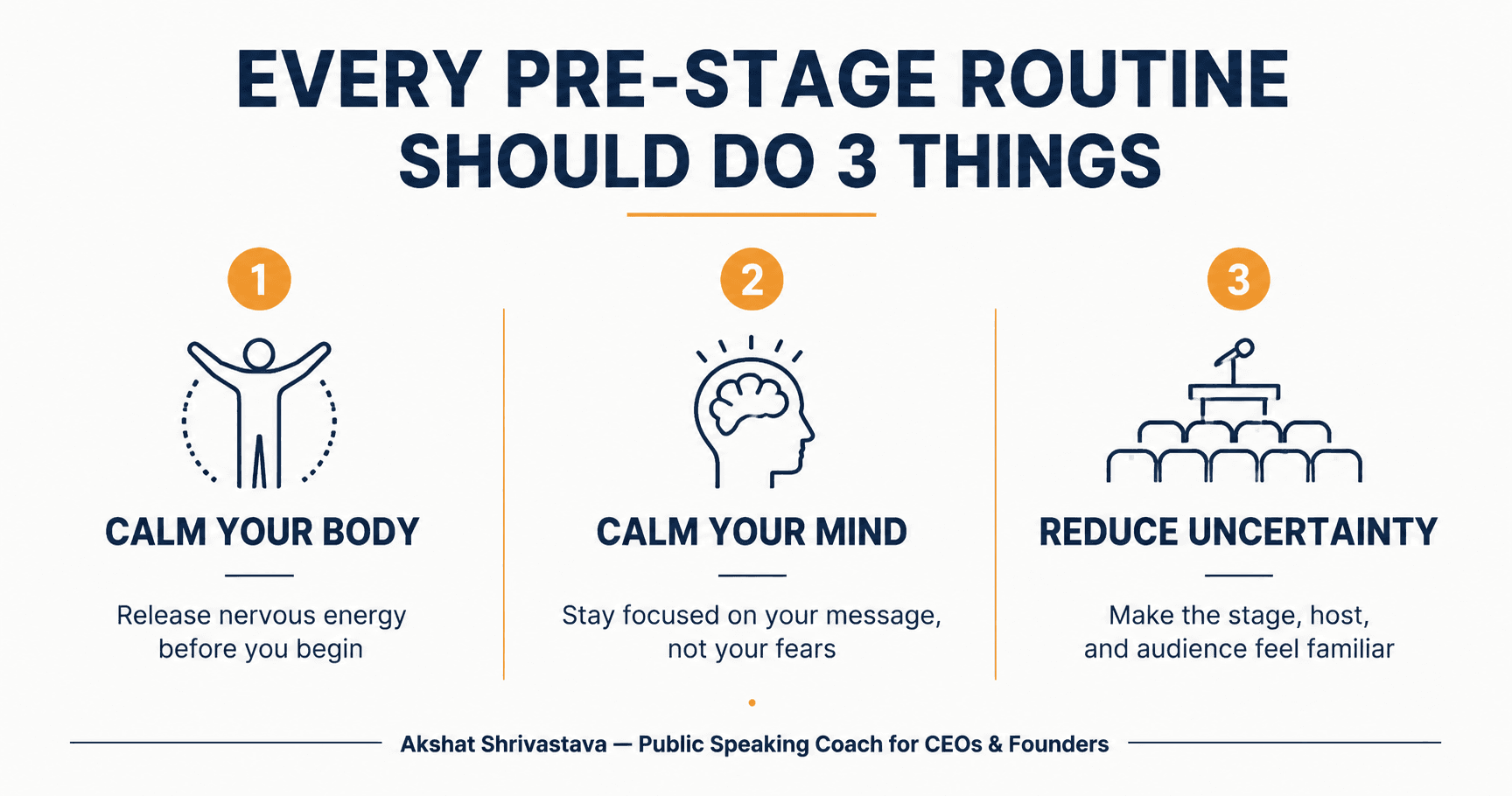
Think of your pre-stage preparation as three simple goals:
- Calm your body so nervous energy doesn’t take over.
- Calm your mind so you stay focused on your message instead of your fears.
- Reduce uncertainty by making the venue, the audience, and the stage feel familiar before you begin.
None of these steps will magically eliminate nerves, and that’s not the objective. The goal is to create the conditions that allow all the preparation you’ve already put into your keynote to shine when you’re standing in front of your audience.
Why Preparation Alone Isn't Enough
People often assume confidence appears moments before they walk on stage. In my experience, that’s rarely how it works.
Confidence is the result of good preparation combined with the right mental state. You might have spent weeks crafting your keynote, but if you spend the final few hours rushing around, replaying worst-case scenarios in your head, and letting your body remain tense, you’ll struggle to access all that preparation.
Professional athletes have routines before competitions. Musicians have rituals before concerts. These routines don’t magically improve their ability. They simply create familiarity and calm before an important performance. Public speaking deserves the same level of intention.
The goal isn’t to eliminate nervousness. A little adrenaline is completely normal. The goal is to make sure your nerves work for you rather than against you. Here’s the exact routine Lauren followed on the day of her keynote.
My 8-Step Pre-Stage Routine
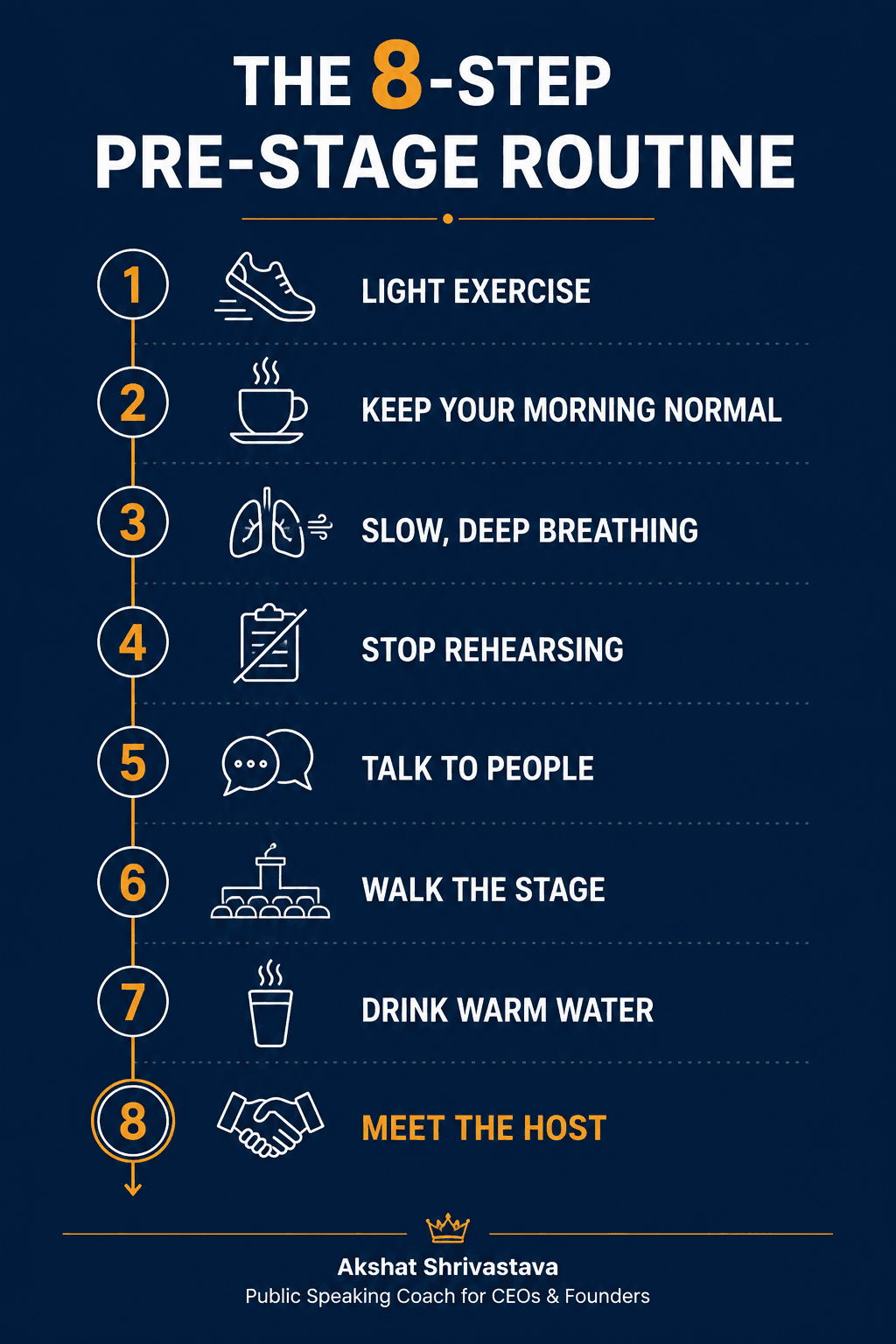
1. Begin the Day with Light Exercise
Lauren started her morning with a light workout at the gym. Notice I didn’t recommend an intense training session. The objective wasn’t to exhaust herself; it was simply to wake up her body and release some of the nervous energy that naturally builds before a high-stakes presentation.
Anxiety creates adrenaline. If that adrenaline has nowhere to go, it often shows up as restlessness, shaky hands, or racing thoughts. A short workout, brisk walk, or even twenty minutes of stretching gives your body an outlet before you step onto the stage.
Before leaving the gym, I also asked Lauren to spend a couple of minutes doing power poses. Power poses are open, expansive body positions that encourage confident posture. While research is mixed on whether they directly increase confidence, many speakers find them useful because they reduce the tendency to physically shrink when anxiety kicks in and serve as a simple reminder to stand with presence.
Stand with your feet shoulder-width apart, keep your shoulders relaxed, lift your chest, and place your hands on your hips. Another option is to raise both arms overhead as if you’ve just crossed the finish line. Hold the position for one to two minutes while breathing slowly.
2. Keep Your Morning Normal
Many speakers unintentionally make keynote day feel stressful. They skip breakfast because they’re nervous, drink far more coffee than usual, or spend every spare minute staring at their slides. I encouraged Lauren to do the opposite.
She had breakfast, enjoyed her usual coffee, and followed her normal morning routine. Familiar routines tell your brain that today is important, but it isn’t dangerous. That small psychological shift helps you stay grounded.
3. Slow Your Nervous System with Deep Breathing
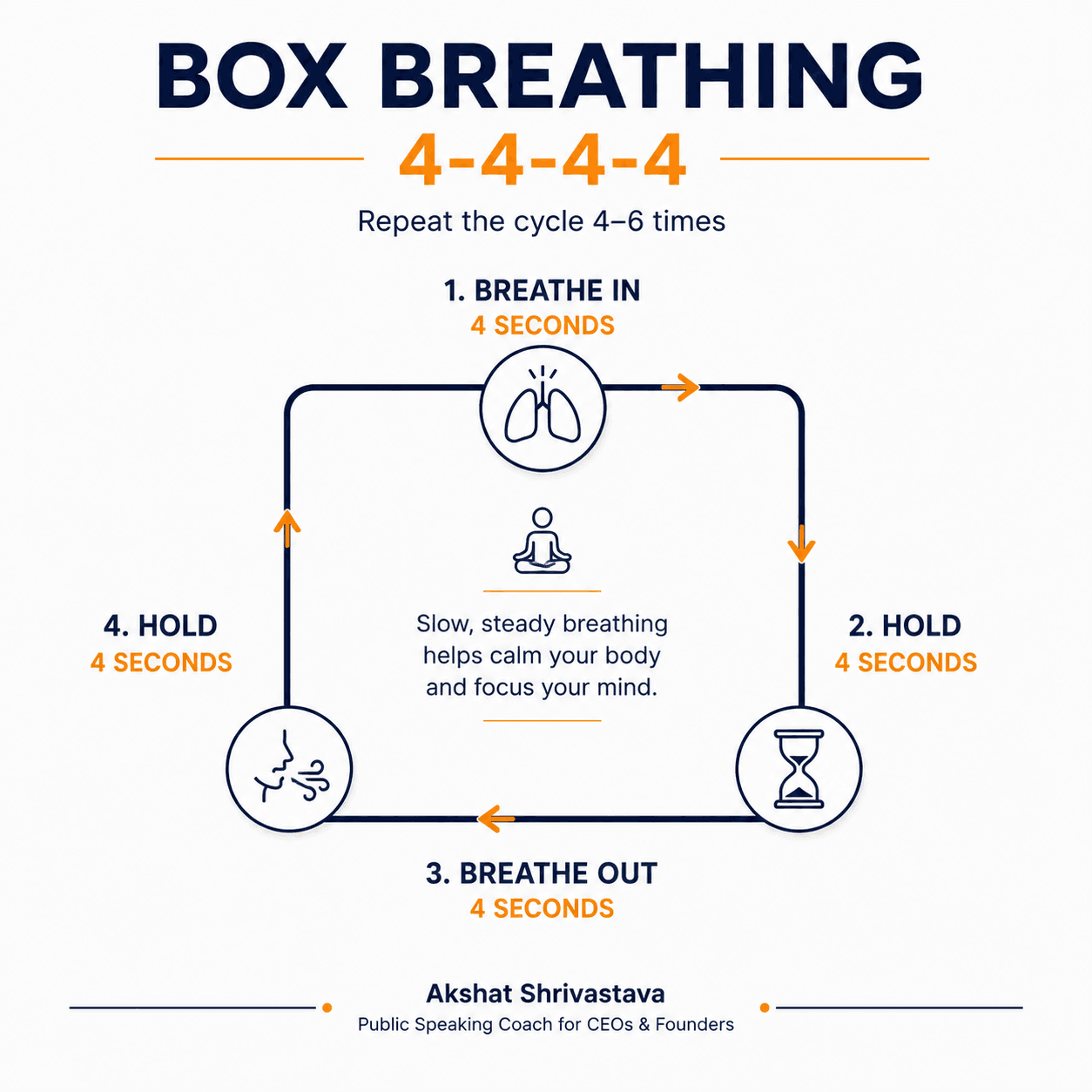
Before leaving for the venue, Lauren spent a few quiet minutes listening to relaxing music and practising breathing exercises. One technique I often recommend is box breathing:
- Breathe in through your nose for 4 seconds.
- Hold your breath for 4 seconds.
- Exhale slowly through your mouth for 4 seconds.
- Hold again for 4 seconds, then repeat four to six times.
Another excellent option is the 3-4-5 breathing technique: inhale for 3 seconds, hold for 4 seconds, and exhale slowly for 5 seconds. The longer exhalation activates your body’s relaxation response and naturally slows your heart rate.
Slow, controlled breathing helps activate your parasympathetic nervous system, which can reduce physical symptoms of anxiety such as a racing heart or shallow breathing. It’s a simple technique, but it can be remarkably effective before walking on stage.
4. Stop Rehearsing Every Minute
This advice surprises many speakers. By the morning of your keynote, your preparation should already be complete. If you’ve spent weeks practising your speech, another hour of frantic rehearsal isn’t likely to make it significantly better. In fact, it often creates more anxiety because you start questioning lines you already knew well.
Instead, I encouraged Lauren to listen to one of her favourite podcasts during her commute. The goal wasn’t distraction for the sake of it. The goal was trust: trust that the work you’ve already done is enough.
5. Talk to People Before You Speak
This is probably my favourite part of Lauren’s routine because I’ve seen it transform so many speakers. Instead of waiting backstage, Lauren spent the morning chatting with attendees at her booth.
The audience stops feeling like a crowd. They become people. You recognise faces, remember conversations, and see smiles from people you’ve already met. By the time you walk on stage, it no longer feels like you’re speaking to hundreds of strangers. It feels like you’re continuing conversations you’ve already started.
6. Spend Five Minutes on the Stage Before Your Session
If the venue allows it, visit the stage before your keynote begins. Walk around it. Stand where you’ll deliver your opening. Look at the seating arrangement. Hold the presentation clicker and test the microphone.
When speakers first experience the stage while the host is introducing them, everything feels unfamiliar. Spending even five minutes in the space beforehand helps reduce uncertainty and makes the stage feel like your own.
7. Drink Warm Water
Many speakers find warm water more comfortable than very cold water before speaking because it helps keep the throat feeling relaxed. The goal isn’t a special performance hack—it’s simply to stay comfortable and avoid unnecessary vocal strain.
You don’t need to drink a large amount just before your session. Small, regular sips throughout the morning are enough.
8. Meet the Host Before You Go On Stage
Finally, I asked Lauren to introduce herself to the event host before the keynote. It sounds like a minor detail, but it helps reduce uncertainty.
You’ll know exactly how you’ll be introduced, where you’ll enter from, and where to stand once your name is announced. Every unknown you eliminate gives your brain one less thing to worry about.
What Happened After Lauren's First Keynote?
A few days after the conference, Lauren and I caught up to reflect on how everything had gone. The first thing she said wasn’t about the applause, the audience, or the business opportunities. She smiled and said, “I was surprisingly very calm throughout the speech.”
I loved hearing that. She hadn’t expected to eliminate every nerve. She had simply hoped not to be controlled by them.
She delivered a keynote she was genuinely proud of. Audience members came up afterwards to continue conversations she’d started from the stage. She received generous feedback, generated business enquiries, and, a few weeks later, shared even more exciting news: she’d been invited to speak at two more conferences, one later in 2026 and another in 2027.
Did the pre-stage routine create those opportunities? Not by itself. Lauren deserves the credit. She prepared thoroughly, rewrote stories that weren’t working, practised consistently, accepted feedback with humility, and put in the effort to improve. The routine simply helped her access all that preparation when it mattered most.
The Biggest Lesson I've Learned Coaching Keynote Speakers
Watching Lauren succeed reminded me of something I believe more strongly with every client I coach: confidence isn’t something you find. It’s something you build.
You build it through thoughtful preparation. You build it through deliberate practice. And you build it by creating routines that help you perform at your best when the pressure is highest.
So if you have an important keynote coming up, don’t ask yourself, “How do I stop feeling nervous?” Ask yourself a better question.
“What can I do before I step on stage that allows my preparation to shine?”
You’ll probably still feel a few butterflies. Most great speakers do. The difference is that those butterflies will be flying in formation instead of all over the place.
Lauren’s routine works because it works for Lauren. Yours might look slightly different — maybe you skip the workout and lean harder on breathing, or you’d rather review your notes once more than sit quietly with music. That’s fine. The goal was never to copy this routine step for step. It’s to build your own version of it: a sequence you trust, that consistently gets you calm, focused, and ready before you walk on stage.
I loved hearing that. She hadn’t expected to eliminate every nerve. She had simply hoped not to be controlled by them.
She delivered a keynote she was genuinely proud of. Audience members came up afterwards to continue conversations she’d started from the stage. She received generous feedback, generated business enquiries, and, a few weeks later, shared even more exciting news: she’d been invited to speak at two more conferences, one later in 2026 and another in 2027.
Did the pre-stage routine create those opportunities? Not by itself. Lauren deserves the credit. She prepared thoroughly, rewrote stories that weren’t working, practised consistently, accepted feedback with humility, and put in the effort to improve. The routine simply helped her access all that preparation when it mattered most.
Frequently Asked Questions
Practice usually happens in a familiar, low-pressure environment. A live keynote introduces an audience, unfamiliar surroundings, and higher stakes, which can trigger your body’s stress response. That’s why preparing your mindset and routine is as important as preparing your speech.
For most speakers, no — and that’s a good thing. What usually changes with experience isn’t the presence of nerves, it’s how quickly they settle. Speakers who’ve been on stage a dozen times still feel a spike of adrenaline in the wings; the difference is they’ve learned to trust that it passes once they start talking. If you’re still dealing with stage fright on your first few keynotes, that’s not a sign you’re unprepared — it’s a sign you care about doing it well.
Avoid alcohol or sedatives to “take the edge off” — they dull your energy and delivery more than they calm you. Skip the urge to check email, Slack, or social media in your final hour; it pulls your focus outward right when you need it inward. And don’t test a new outfit, new slides, or new equipment on keynote day — anything unfamiliar adds a small variable you don’t need. Save the surprises for a day when nothing’s riding on it.
Aim to arrive 45–60 minutes before your session, or earlier if the event allows. That buffer is what makes Steps 6 and 8 above possible — enough time to walk the stage and meet your host without feeling rushed.
Absolutely. Confidence isn’t a personality trait—it’s a skill developed through preparation, deliberate practice, and experience. Many outstanding keynote speakers identify as introverts. What sets them apart is not being naturally outgoing, but having a clear message and a repeatable process for delivering it.
Yes, if they’re used as anchors, not a script. Most experienced keynote speakers work from a short list of section headers or key transitions, not full sentences. Reading directly from notes, or from your slides, breaks eye contact and flattens your delivery. The goal by keynote day, per Step 4 above, is to know your material well enough that notes are a safety net, not a crutch.
Preparing for Your Own Keynote?
Knowing how to feel confident before a keynote speech isn’t about eliminating nerves — it’s about building a routine you can trust every time you walk on stage.
If you’re preparing for a high-stakes keynote, TEDx talk, conference presentation, or leadership speech, I’d love to help. My coaching programs are designed for CEOs and founders who want to communicate with Power, Presence, and Authority. If you’d like support preparing for your next big stage, explore Keynote Coaching and let’s build a keynote you’ll be proud to deliver.