
In 2020, when I started working as a Public Speaking Coach, I coached almost everyone – IT professionals, managers, sales executives, Vice Presidents, entrepreneurs.
My approach was fairly simple: understand their challenges, put them through realistic speaking situations, practise, give feedback, and repeat.
Over the next few years, my coaching became increasingly in-depth. I began to realise that public speaking was rarely about simply learning a set of techniques. Every person had different strengths, different speaking situations, different insecurities and different habits that needed attention.
Eventually, I had more people to coach than I could handle. I was burning out.
Then a global CEO reached out to me. He was leading a company with more than 23,000 employees, and I worked with him closely for three months. That experience changed how I looked at my own coaching.
I realised that the work I was doing was particularly relevant to CEOs and Founders. Their communication challenges were rarely limited to giving a speech. They had to communicate ideas to employees, investors, customers, industry audiences and other senior leaders. They had to move comfortably between a town hall, an investor presentation, a panel discussion, a podcast and a keynote.
The stakes were often higher, and the communication needed to be much more intentional.
In 2024, I decided to narrow my coaching practice to CEOs and Founders. Since then, I’ve worked in depth with business leaders and developed a much clearer understanding of what actually helps someone become a powerful speaker.
The biggest lesson I’ve learned is that becoming a powerful speaker isn’t primarily about learning more public speaking techniques. It is about developing awareness of yourself as a speaker and deliberately improving through real speaking situations.
If you’re a CEO or Founder and want to improve your public speaking, here’s how I would approach it.
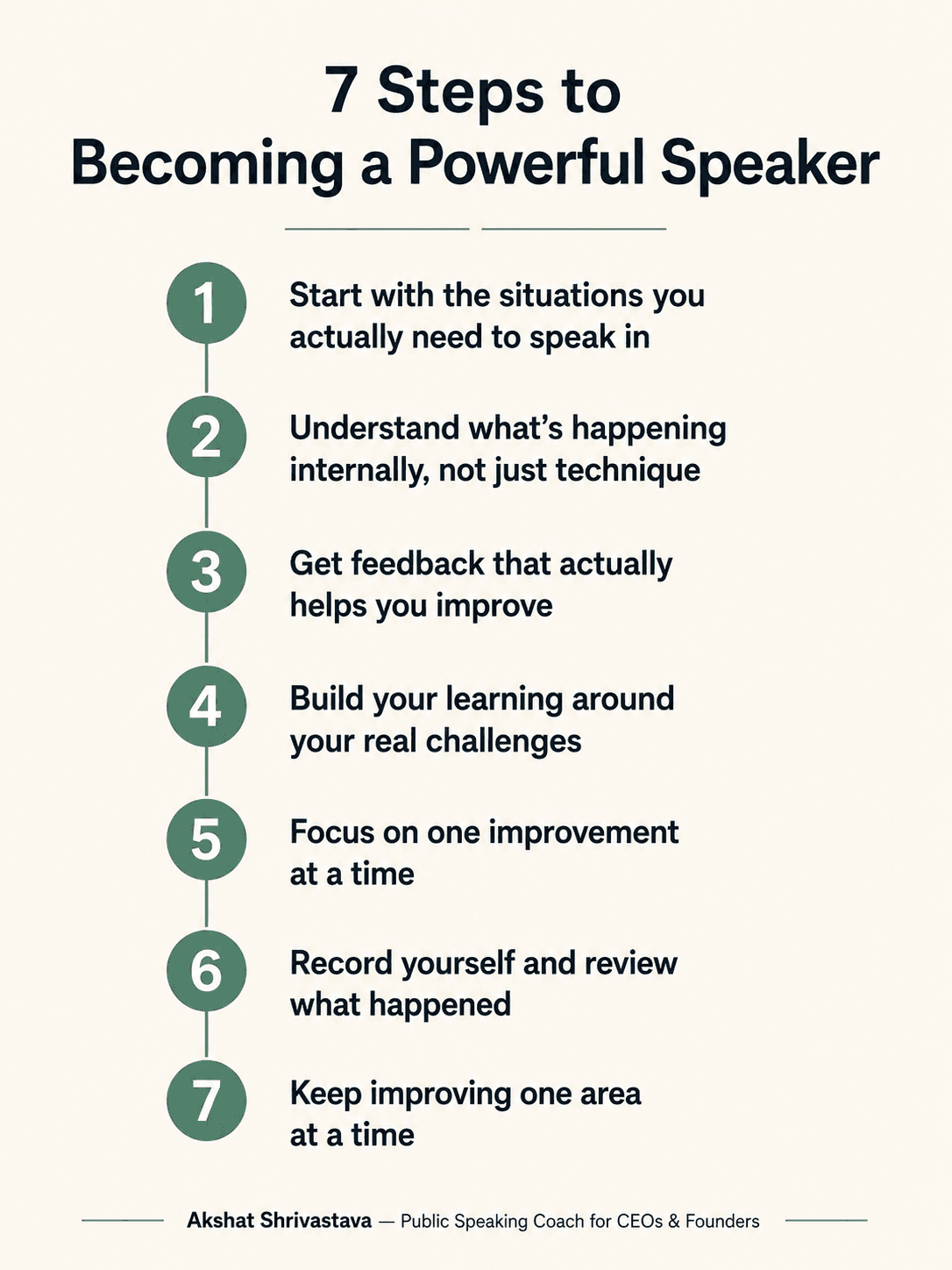
1. Start with the situations in which you actually need to speak
One of the first things I do with a new client is understand where they actually need to communicate.
In February 2026, I started working with Jai, a fifth-generation businessman from a large business family in India. When he reached out, I quickly realised that he didn’t need to become better at just one type of speech. His professional life required him to communicate in several very different situations.
So instead of putting him through a generic public speaking curriculum, we built his coaching around the situations he was likely to encounter: town halls, social speeches, keynotes, investor presentations and impromptu speaking.
By the end of the program, he had a much clearer idea of how to approach each situation.
This is an important starting point because public speaking isn’t one skill.
A CEO might need to address employees at a town hall one day, present to investors the next, participate in a panel discussion a few weeks later, record a podcast and eventually deliver a keynote at an industry conference. All of these involve speaking, but they require different approaches.
A person who is excellent in a boardroom but struggles on stage has a different development need from someone who is already a strong keynote speaker but struggles with investor questions.
So begin by making a list of your actual speaking situations. Then ask yourself which of them matters most to you right now.
You don’t need to become equally good at everything. You need to understand where becoming better will make the biggest difference.
2. Look beyond technique and understand what is happening internally
Once you know where you need to improve, the next question is harder: what is actually getting in your way?
When I started working with Sachin, a CEO of a technology company in India, I noticed that he had difficulty slowing down and taking pauses. We practised it repeatedly, but the problem wasn’t going away.
So I stopped treating it as simply a delivery problem and started looking for the internal narrative behind it. We discovered that Sachin had been spending quite a lot of time consuming social media content. Short-form videos are edited for speed. Pauses are removed, sentences are compressed and the pace is deliberately increased to hold attention.
Over time, his mind had started associating speed with engagement. He had developed an unconscious belief that if he slowed down, he would lose the audience.
In a live presentation, however, the opposite was often true. A pause gave the audience time to process an important idea and made him appear more composed and confident.
This experience reinforced something I have seen repeatedly in coaching: many speaking problems are not knowledge problems. They are awareness problems.
I’ve worked with speakers who know they should slow down but still rush whenever they become nervous. Some constantly look at their slides because they don’t fully trust themselves without them. Others become overly formal because they’re trying too hard to sound like a leader.
You can learn speech structures, storytelling, body language and vocal variety, yet continue to struggle if you don’t understand the habits and beliefs driving your behaviour.
Pay attention to yourself before and during a speaking situation. Do you rush when you’re nervous? Do you over-explain? Do you become monotone because you’re trying to sound serious? Do you depend too heavily on your slides? Do you become less expressive because you’re worried about appearing unprofessional?
The more accurately you can identify these patterns, the easier it becomes to work on them.
3. Get feedback that actually helps you improve
Self-awareness is important, but there is another problem: you can’t completely see yourself from the outside.
One of the earliest lessons I learnt when I started speaking at Toastmasters was that you should be careful about asking someone, “How was my speech?”
The problem is that most people will give you a polite answer. They don’t necessarily want to tell you what went wrong.
My mentor, Aalap Mehta, taught me to ask much more specific questions after a speech.
Did I speak too quickly? Was my main point clear? Where did you lose attention? Which part felt most engaging? Did I appear confident? Was there anything I did repeatedly that distracted you?
Those questions changed the quality of feedback I received. Instead of simply hearing whether someone liked the speech, I started getting information I could actually use.
The same principle applies to CEOs and Founders. Ask trusted colleagues, peers, mentors or advisors for specific feedback after an important presentation.
At the same time, don’t assume every piece of feedback is equally valuable. Someone might tell you that your presentation was boring, but they may not know whether the problem was your content, structure, delivery or audience connection.
Look for patterns instead.
If different people notice the same thing across different presentations, pay attention. Recurring feedback is much more valuable than a single person’s opinion.
4. Build your learning around your actual challenges
Once you understand your speaking situations, internal challenges and external feedback, you can figure out what you actually need to learn.
This is where AI can be useful.
Instead of randomly consuming public speaking videos, books and courses, you can use AI to organise your learning around your specific challenges. Give it your speaking situations, the problems you’ve identified and the feedback you’ve received, and ask it to create a structured learning plan.
For example, your plan might include speech structure, storytelling, vocal variety, pauses, body language, impromptu speaking, handling difficult questions and audience engagement. The important thing is that these concepts are prioritised based on your actual needs.
The value isn’t in getting AI to teach you everything about public speaking. The value is having a map.
You know what to learn, what to practise and how to evaluate your progress.
But there is an important distinction here: learning is not the same as improvement. AI can help organise your learning, but it cannot replace real-world practice, honest feedback or expert observation.
You still have to get up and speak.
5. Focus on one improvement during your next speech
When I started delivering my first few keynotes, I made a mistake that I now see many speakers make.
I tried to improve everything at once.
I would think about my storytelling, body language, eye contact, vocal variety, pauses, stage movement and content while simultaneously trying to remember what I wanted to say.
Instead of becoming a better speaker, I became a speaker who was thinking too much about speaking.
Eventually, I realised that improvement works better when you isolate one skill.
If you know that you speak too quickly, make pace and pauses your focus for your next presentation. If storytelling is your weakness, focus on making one story more vivid. If your body language is distracting, pay attention to your movement and physical presence.
You don’t need to fix everything in one speech.
Think of every presentation as an opportunity to run one deliberate experiment. Work on one thing, observe what happens and carry that learning into the next presentation.
6. Record yourself and review what actually happened
Recording yourself is one of the simplest ways to become more aware of your speaking. It can also be uncomfortable.
When I started reviewing my own speeches, I noticed things I wasn’t aware of while speaking. There were habits that felt completely normal in the moment but became obvious when I watched the recording.
That is precisely why recording is useful.
The key is to avoid watching the video simply to criticise yourself. Watch it with a specific question in mind.
If your focus was pace and pauses, evaluate only pace and pauses. Did you rush through important points? Did you pause after key ideas? Was your pace comfortable for the audience? Did you slow down when you wanted to create emphasis?
You can also ask someone you trust to watch the same recording and give you feedback on that specific area.
This creates a feedback loop between what you think you’re doing and what you’re actually doing.
Speak. Record. Review. Learn. Speak again.
Over time, the gap between perception and reality begins to shrink.
7. Keep improving one area at a time
Once you’ve worked on one skill, move to the next.
Maybe your next focus is storytelling. Then vocal variety. Then body language. Then impromptu speaking. Then handling difficult questions.
My first public speaking mentor, Aalap Mehta, used to tell me that every speech should challenge you in some way.
I still believe that.
You don’t need to reinvent your speaking style every time you step on stage. You simply need to make every speech an opportunity to improve something.
Over time, these improvements compound.
This is particularly important for CEOs and Founders because speaking isn’t an occasional activity in their professional lives. Your communication can shape how employees understand your vision, how investors perceive your thinking and how your industry perceives your expertise.
You are going to keep speaking.
You might as well keep getting better at it.
The Three Areas I Focus On With CEOs and Founders
The seven steps above describe how to improve as a speaker. But what exactly should you improve?
In my 1:1 Executive Speaking Coaching , I organise the work around three core areas: Unique Speaker Persona, Captivating Content Modelling and Speech Delivery Tactics.
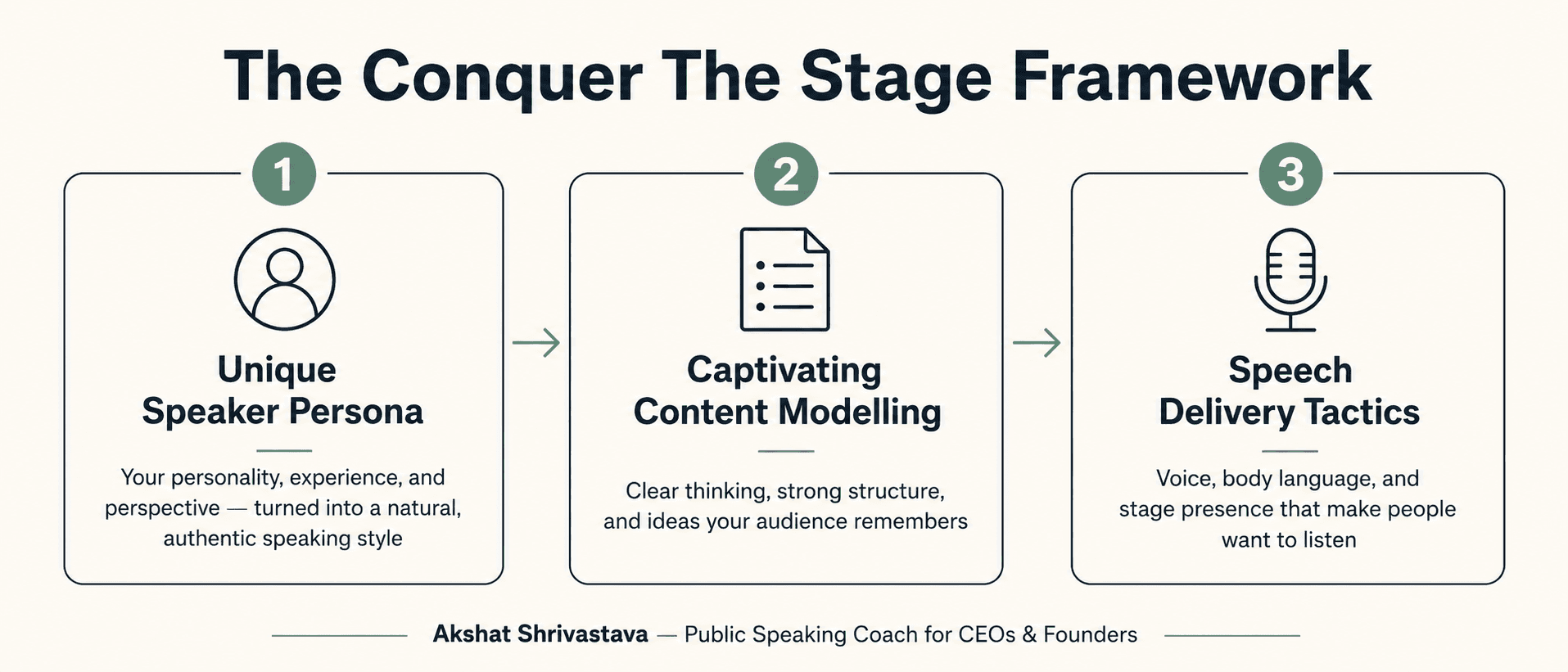
1. Develop your Unique Speaker Persona
Your greatest advantage as a speaker is something nobody else can replicate: your personality, experience, stories and perspective.
This is why I don’t believe CEOs and Founders should simply copy speakers they admire.
A Founder who has spent ten years building a company has experiences, failures, decisions and lessons that no public speaking course can manufacture. Those experiences are your raw material.
The goal is to understand what makes you uniquely effective as a speaker and turn those experiences into a speaking style that feels natural and authentic.
2. Turn your ideas into memorable content
Great delivery cannot rescue unclear thinking.
Many presentations are forgotten because the message isn’t clear, the structure is weak, the language is unnecessarily complicated or there isn’t enough connection with the audience.
This is why becoming a powerful speaker also requires learning how to think about and structure your ideas.
Your audience should understand what you’re saying, remember the important parts and know why those ideas matter to them.
3. Improve how you deliver your message
Finally, there is delivery.
You can have a brilliant idea and still lose your audience if you speak too quickly, use the same vocal tone throughout, fail to pause, stand rigidly or rely too heavily on your slides.
That’s why I work with clients on voice projection and modulation, body language and stage movement, as well as speaking without preparation.
The three areas work together. You need something worth saying. You need to structure it well. And you need to deliver it in a way that makes people want to listen.
The Real Secret to Becoming a Powerful Speaker
There is no single public speaking technique that suddenly makes someone powerful on stage.
It is a process.
You understand where you need to speak. You identify what is holding you back. You get honest feedback. You learn the concepts that address those challenges. You practise one skill at a time. You record yourself. You review your progress. Then you do it again.
Most importantly, don’t try to sound like another great speaker you’ve watched online.
Your personality, experience and perspective are already your greatest assets. The goal is to turn those assets into a speaking style that feels natural to you and valuable to your audience.
Frequently Asked Questions
How long does it take to become a powerful speaker as a CEO or Founder?
There’s no fixed timeline — it depends on how many speaking situations you’re actively working through and how consistently you apply feedback. Progress compounds over time rather than happening in a single milestone moment.
Is this approach only for CEOs and Founders who struggle with public speaking, or also for those who are already good speakers?
Both. Even experienced speakers have blind spots — a strong boardroom communicator might struggle on a keynote stage, or a confident presenter might freeze during unscripted Q&A. The process in this post is about identifying where you specifically need to improve next, not fixing a single starting-point problem.
Can I follow this process on my own, or do I need a coach?
You can start applying these steps independently — recording yourself, seeking specific feedback, and focusing on one skill at a time will move the needle. A coach adds real value where self-assessment has limits: spotting patterns you can’t see in your own recordings, and giving you an outside, expert read on what’s actually holding you back.
Ready to Become a More Powerful Speaker?
If you’re a CEO or Founder who wants to become a more confident, clear and impactful speaker across keynotes, conferences, business meetings, presentations and other high-stakes situations, Executive Speaking Coaching is my 90-day 1:1 public speaking coaching program designed to help you do exactly that. If your immediate need is a specific upcoming keynote, explore Keynote Coaching instead.
You don’t need to become someone else on stage.
You need to become a more powerful version of yourself.