Over the past six years, I’ve attended conferences across India and around the world.
Sometimes I’ve been invited as a keynote speaker. Sometimes I’ve been there to coach a client before they walked on stage. And quite often, I’ve simply sat quietly in the audience with a notebook, watching speakers far more closely than most people probably do.
I don’t just listen to what they say.
I’m curious about everything that happens before the speech truly begins. I watch how they walk onto the stage, where they look first, how quickly they start speaking, whether they pause, and how the audience responds during those first few moments.
After watching hundreds of keynote speeches, one pattern has become impossible for me to ignore.
Even highly accomplished CEOs, founders, and business leaders often waste the most valuable moment of their keynote.
They walk confidently onto the stage, smile at the audience, and begin with something like:
“Good morning, everyone.”
“Hi, I’m Raj, and I’m excited to be here.”
“Thank you so much for inviting me.”
There’s absolutely nothing wrong with these words. They’re polite, respectful, and well-intentioned.
They’re also completely forgettable.
If you want to know how to open a keynote speech in a way that people actually remember, you don’t necessarily need to say something dramatic. You simply need to give the audience a reason to pay attention.
The opening of your keynote is one of the few moments when every single person in the room is looking at you. Before emails, notifications, and wandering thoughts begin competing for attention, you have a brief window where the audience is fully present.
The question is: what will you do with that moment?
The audience is deciding long before your ideas arrive
Most speakers assume that people evaluate them after hearing a few minutes of content.
I don’t think that’s true.
Long before the audience decides whether they agree with your ideas, they’re forming an opinion about you.
Can I trust this person?
Do they seem confident?
Is this going to be worth my attention?
Should I put my phone away?
Those questions aren’t answered by the quality of your slides or the depth of your expertise. They’re often answered before your second sentence.
I’ve seen remarkable speakers lose momentum because they began exactly like every other speaker. I’ve also seen average speakers immediately capture the room simply because they created curiosity before they started explaining anything.
That’s why I believe the opening of a keynote deserves far more attention than most people give it.
Your keynote opening isn’t just an introduction. It’s the moment that sets the expectation for everything that follows
The moment that changed how I think about keynote openings
In November 2025, I attended a TEDx event with six speakers.
By the time the third speaker had walked on stage, I found myself predicting how each talk would begin.
“Thank you for having me.”
“It’s an honour to be here.”
“Good evening, everyone.”
I wasn’t doing this to be critical. I was simply noticing a pattern.
Each speaker had a unique story and a unique message. Yet somehow, the first thirty seconds of every talk sounded almost identical.
Then the final speaker walked onto the stage.
There was no greeting.
No introduction.
No explanation of who they were.
They simply shared an idea.
The room changed almost instantly. People stopped shifting in their seats. A few phones disappeared. You could almost feel everyone’s attention moving in the same direction.
Nothing dramatic had happened.
The speaker hadn’t used theatrics or humour.
They had simply understood that the audience came to hear an idea, not an introduction.
That afternoon reminded me that originality doesn’t always require saying something extraordinary.
Sometimes it simply means avoiding what everyone else is doing.
We've been taught to start small
Early in 2025, I began coaching the CEO of a pharmaceutical company for an important industry keynote.
Every rehearsal started the same way.
He thanked the organisers.
He thanked the audience.
He thanked the sponsors.
Only then did he begin his actual keynote.
When I asked why he always started this way, his answer was immediate.
“I thought that’s what you’re supposed to do.”
I think many of us have learned the same habit. We associate gratitude with good manners, and we assume the safest opening is also the best opening.
But the safest opening is rarely the most memorable one.
I suggested something different.
“What if we didn’t remove the gratitude? What if we simply moved it?”
Instead of opening with thanks, we opened with a compelling observation that immediately connected with the audience’s biggest challenge. Once everyone was engaged, he naturally acknowledged the organisers and thanked them for the invitation.
The gratitude felt warmer.
The opening felt stronger.
And most importantly, the audience had a reason to keep listening.
That experience reinforced something I now tell almost every client.
You don’t have to choose between being gracious and being memorable.
You can do both – just not in the same sentence.
The opening changes the speaker too
One of the biggest surprises in my coaching journey has been realizing that a great opening doesn’t only influence the audience.
It changes the speaker.
I still remember preparing for the Toastmasters International Speech Contest in 2019.
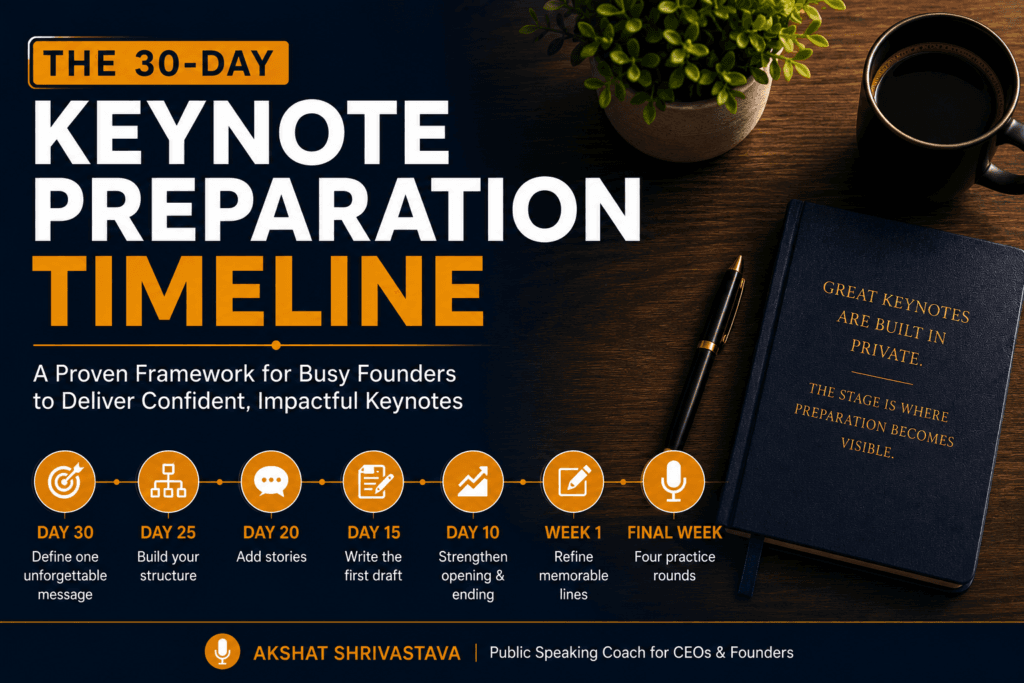
I rewrote my opening over and over again. I don’t remember the exact number anymore, but it must have been close to ten different versions before I finally settled on one that felt right. (If you’re mapping out your own prep schedule, my 30-day keynote preparation timeline shows exactly where opening refinement fits into the process.)
At the time, I thought I was obsessing over a few unnecessary lines.
Looking back, I wasn’t refining an introduction.
I was building confidence.
Once I knew exactly how I wanted to begin, everything else became easier. I walked onto the stage feeling calmer because I wasn’t wondering whether the audience would engage. I already believed they would.
I’ve seen the same transformation happen with clients.
One executive I coached was the Director of a ₹3,000+ crore company in India. We made several improvements to his keynote, but the biggest shift came after we redesigned the first minute of his speech.
His confidence changed.
His body language changed.
His pace changed.
Sometimes the fastest way to improve the last twenty minutes of a keynote is to improve the first sixty seconds.
The most underrated speaking technique I know
Almost every nervous speaker has one thing in common.
They rush.
The moment they reach centre stage, they begin talking.
I’ve done it myself.
Recently, I noticed the same pattern while coaching a SaaS founder for a conference keynote. Every rehearsal looked identical. He walked on stage and immediately started speaking, almost as if he wanted to get the first sentence over with before nervousness could catch up.
The faster he spoke, the less confident he appeared.
So I asked him to try something that feels uncomfortable at first but almost always works.
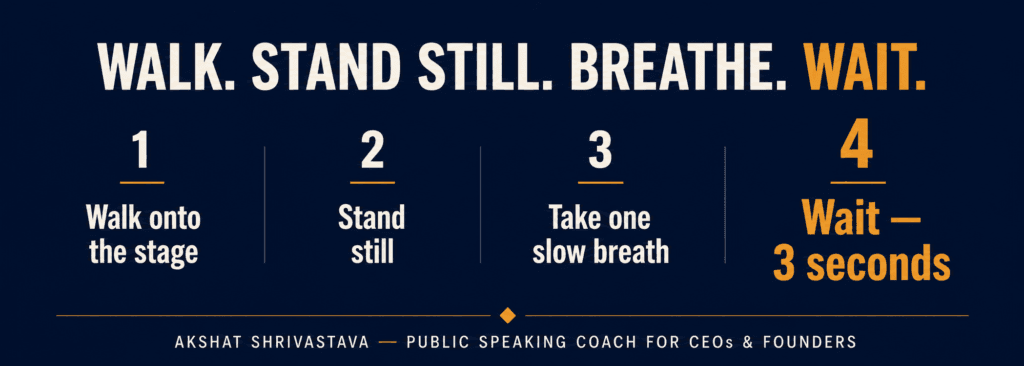
Walk onto the stage.
Stand still.
Look at the audience.
Take one slow breath.
Then wait.
Just three seconds.
Those three seconds feel much longer to the speaker than they do to the audience.
To everyone else, you simply look calm and composed.
Silence creates anticipation.
It gives the audience time to settle.
More importantly, it gives you permission to arrive mentally before asking everyone else to follow you.
The best keynote speakers I’ve watched are never afraid of silence.
They know it is part of the speech.
To everyone else, you simply look calm and composed.
Silence creates anticipation.
It gives the audience time to settle.
More importantly, it gives you permission to arrive mentally before asking everyone else to follow you.
The best keynote speakers I’ve watched are never afraid of silence.
They know it is part of the speech.
Five ways to open a keynote that people remember
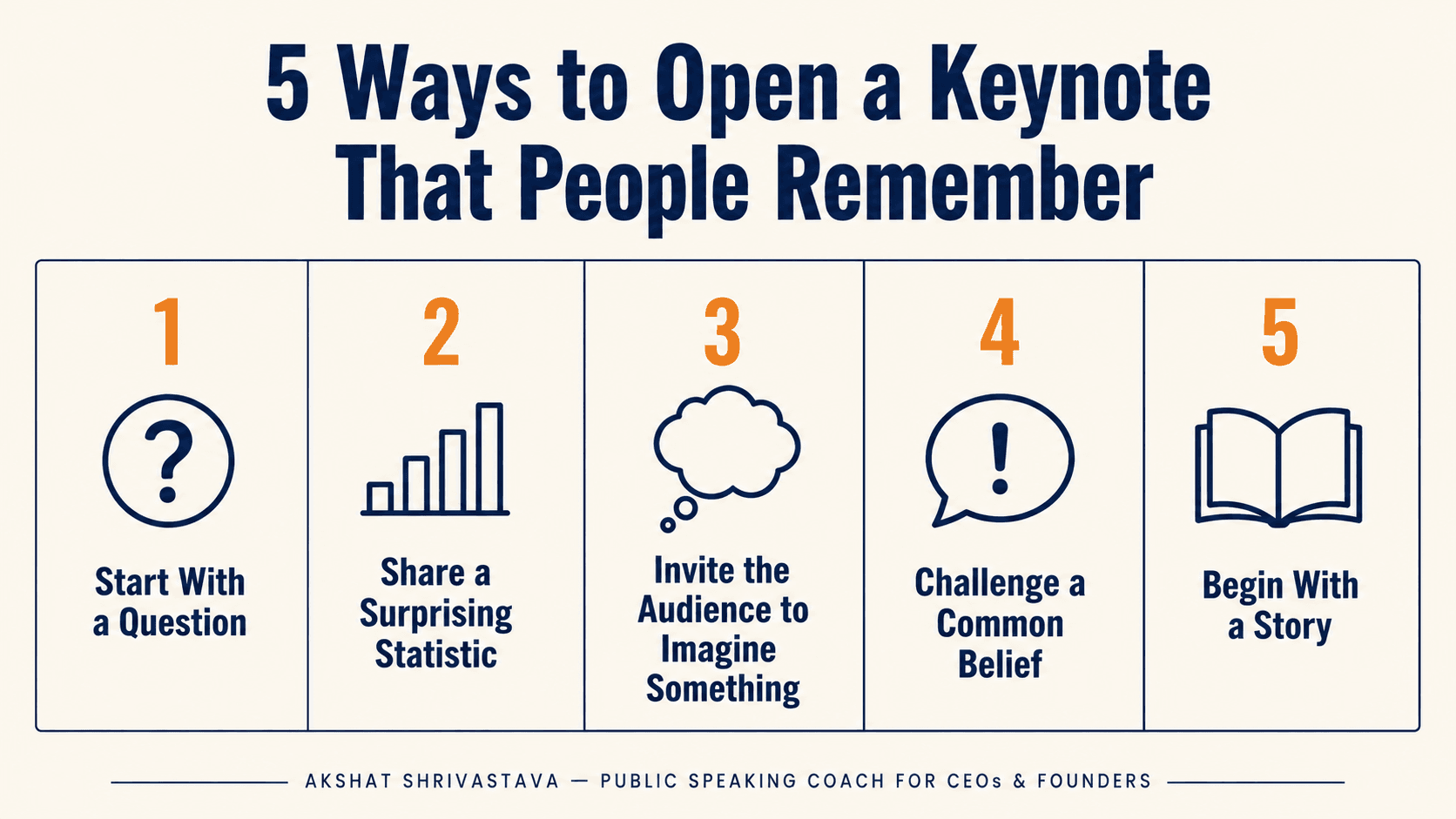
Over the years, I’ve experimented with different ways of opening my own talks and helped clients discover what suits their personality and message. There isn’t one single way to start a keynote speech, but the following five approaches consistently work.
Start With a Question
This is my favourite, and probably the technique I use most often. A thoughtful question instantly moves the audience from passive listening to active thinking. Before you’ve shared a single insight, people are already participating in the conversation.
Share a Surprising Statistic
A relevant statistic creates curiosity because it challenges what people assume to be true. Just make sure it’s accurate and directly connected to the point you’re about to make.
Invite the Audience to Imagine Something
The word imagine is wonderfully powerful. It allows people to experience your idea before you explain it. A vivid mental picture often creates more engagement than several minutes of information.
Challenge a Common Belief
When you respectfully question conventional wisdom, people naturally become curious. They want to know what you’ve discovered that they haven’t. Of course, curiosity must eventually be rewarded with evidence, stories, and practical insights.
Begin With a Story
Stories remain my favourite way to create emotional connection. Before audiences remember data, frameworks, or strategies, they remember people. A well-told story earns attention because it makes people feel something before asking them to think.
How Do You Choose the Right Keynote Opening?
The best opening isn’t necessarily the most dramatic one.
It’s the one that naturally leads into the message you want the audience to remember.
A question works when you want people to think.
A statistic works when you want to challenge an assumption.
A story works when you want people to feel something.
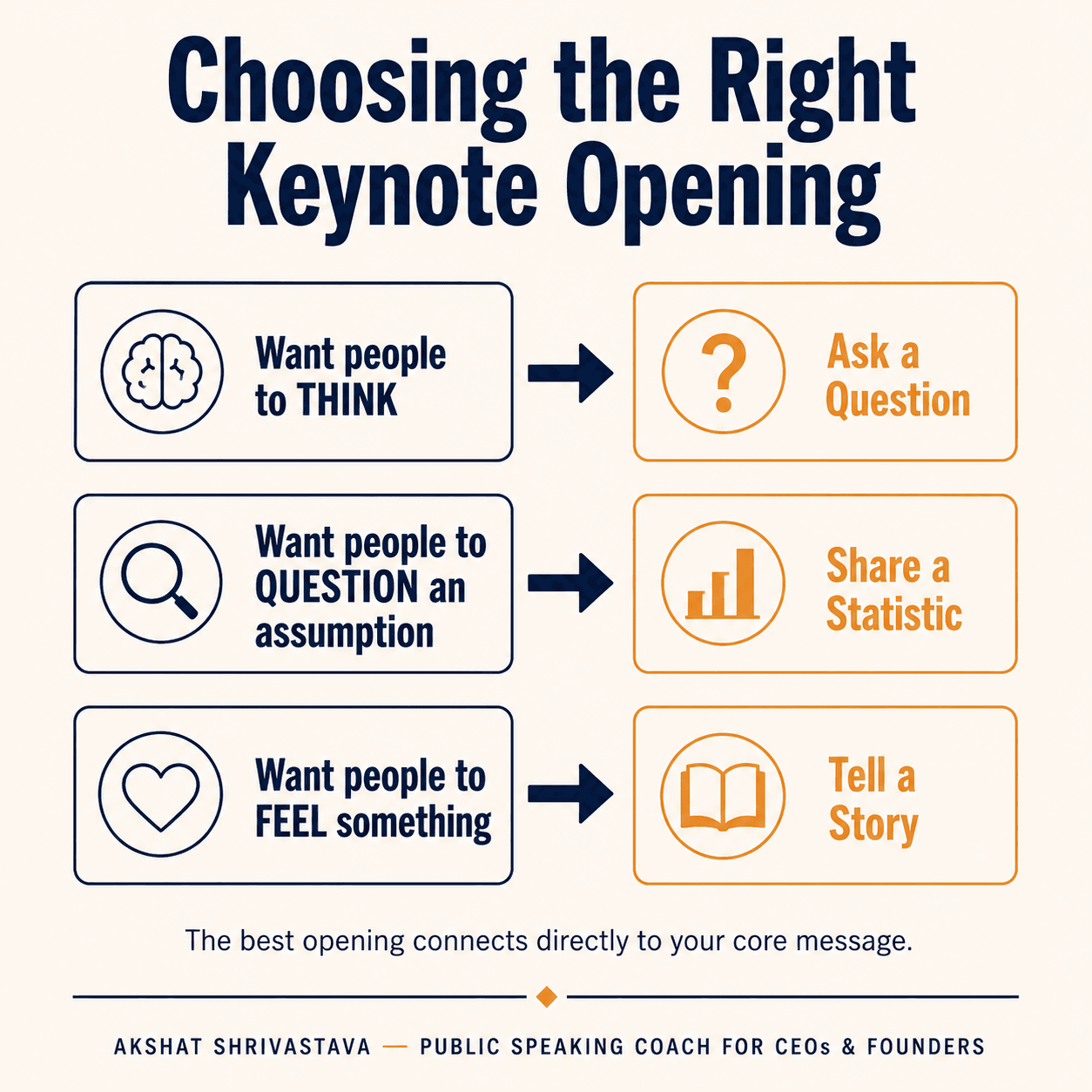
Whatever approach you choose, your opening should feel connected to the rest of your keynote. If you could remove the opening without changing anything that follows, it probably isn’t doing enough work.
That’s also why the opening can’t be designed in isolation — it has to connect to how the rest of your keynote is built. If you’re still shaping that broader flow, my guide on how to structure a keynote speech walks through the full process.
Your audience won't remember your greeting
Years after a keynote, nobody remembers whether the speaker said, “Good morning.”
They remember the story that stayed with them on the flight home.
They remember the question they couldn’t stop thinking about.
They remember the silence before the speaker’s first sentence.
Most of all, they remember how the keynote made them feel.
That’s why I no longer think of an opening as an introduction.
I think of it as an invitation.
It’s your invitation into the audience’s attention, curiosity, and trust.
The next time you walk onto a stage, resist the temptation to begin with, “Hi, I’m…” or “Thank you for inviting me.”
Pause.
Let the room settle.
Lead with an idea that matters.
Because great keynote speakers don’t capture attention after they begin speaking.
They capture it before they say their first word.
Frequently Asked Questions
Should You Introduce Yourself at the Beginning of a Keynote?
You can introduce yourself, but you don’t necessarily need to make it your first sentence. I prefer to begin by creating curiosity and introduce myself naturally once the audience has a reason to keep listening.
Should You Thank the Organisers at the Beginning of a Speech?
Absolutely, but gratitude doesn’t have to be the first thing you say. You can open with an idea, question, or story, and acknowledge the organisers once you’ve captured the audience’s attention.
How Long Should a Keynote Opening Be?
There is no fixed rule for how long a keynote opening should be. However, for a TEDx-style 18-minute keynote speech, a good opening typically lasts 30–60 seconds. An opening that is too short may feel abrupt, while one that is too long may dilute its impact.
Preparing for an Important Keynote?
If you’re preparing for a keynote, TEDx talk, investor presentation, leadership address, or conference speech, I’d love to help.
Over the past six years, I’ve coached more than 100 leaders to speak with power, presence, and authority on stage. If you want structured support to communicate your ideas with greater clarity, confidence, and impact, explore Keynote Coaching. Whether you have an important speech coming up or want to become a more compelling speaker overall, you’ll find support designed around your goals.