A few months ago, I started working with Andrea, an Italian entrepreneur who runs multiple SEO and marketing agencies across Italy and Australia.
Like many successful founders, Andrea wasn’t short on expertise. He had spent years building businesses, solving complex client problems, leading teams across continents, and developing insights that only come from experience.
Then he received an invitation that changed everything.
He had been invited to deliver a 40-minute keynote at the SEO Mastery Summit 2026 in Ho Chi Minh City. It would be his first keynote on an international stage, speaking to an audience of founders, agency owners, and marketers from around the world. Naturally, he wanted to make it count.
Most people assume that preparing a keynote is primarily about becoming more confident on stage. That wasn’t Andrea’s problem.
He wasn’t worried about stage fright. He wasn’t worried about speaking in English. His biggest challenge was something I see repeatedly when coaching CEOs and founders.
He had too many ideas.
During our first coaching session, every conversation opened up another thread. He wanted to talk about scaling agencies, building teams, client relationships, AI, entrepreneurship, leadership, and the lessons he’d learned over years of building successful businesses. Every story felt important. Every framework deserved a place in the keynote. Within an hour, we had pages of valuable material.
The challenge wasn’t finding content.
The challenge was deciding what deserved to stay.
That tension is exactly what makes it so hard to structure a keynote speech when you have more expertise than time.
If you’ve spent years building expertise, this problem probably sounds familiar. Beginners struggle because they don’t know what to say. Experts struggle because they’ve accumulated so much knowledge that everything feels important.
Ironically, that’s exactly where most keynote speeches go wrong.
If you’re still shaping the broader speech — audience, story, delivery — my guide on how to write a keynote speech that audiences remember covers that full process. This post zooms into the one problem experts run into most: too many ideas.
When speakers receive an opportunity to address a large audience, their instinct is to maximize value by maximizing content.
“I only have 40 minutes.”
“I should give them everything I know.”
It’s an understandable thought. After all, you’ve spent years building your expertise. You want the audience to walk away feeling they received tremendous value.
Unfortunately, the opposite usually happens.
Instead of delivering one memorable keynote, speakers end up delivering five mini presentations stitched together. They jump from one topic to another, introduce multiple frameworks, share unrelated stories, and hope the audience connects the dots.
The audience rarely does.
Human beings don’t remember information simply because it’s valuable. They remember information because it’s organized. When too many ideas compete for attention, none of them become memorable.
There’s another consequence that many speakers don’t realize.
Trying to share everything often makes you appear less authoritative.
The strongest experts don’t demonstrate everything they know. They demonstrate remarkable clarity about what matters most.
That’s the shift we needed to make with Andrea’s keynote.
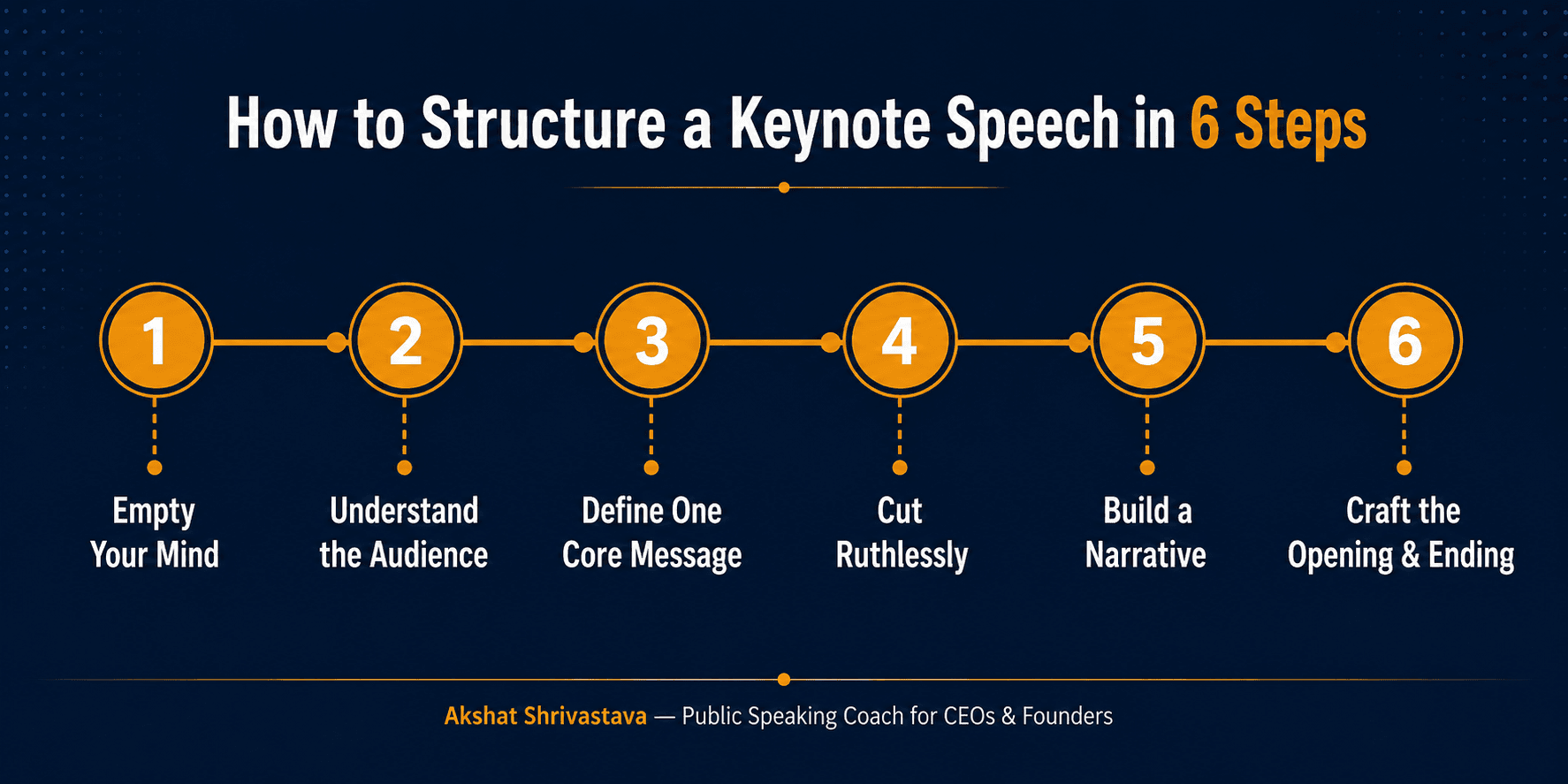
Most speakers make the mistake of opening PowerPoint before they’ve finished thinking.
They create a few slides, remember another idea, rearrange the presentation, think of another story, add another slide, and repeat the process over and over again.
Instead, I asked Andrea to spend our first session doing something much simpler.
Talk.
That’s it.
For almost an hour, he shared every lesson, framework, story, client example, and observation that came to mind while I documented everything.
Nothing was judged.
Nothing was organized.
Nothing was removed.
This exercise serves an important purpose. Before you can prioritize ideas, you first need to get them out of your head.
Once everything is visible on paper, your mind becomes quieter. You stop worrying about forgetting something and can begin looking at your ideas objectively.
Think of this stage as collecting raw material, not building the speech.
Once we had pages full of ideas, the next question wasn’t, Which ideas are best?
It was, Which ideas matter most to this audience?
This distinction changes everything.
Before writing a keynote, spend time understanding who will actually be sitting in the room.
Ask yourself:
- Who are they professionally?
- What challenges are they facing today?
- What do they already know about the topic?
- What are they hoping to learn from you?
- What should they think differently by the end of your keynote?
When Andrea and I answered these questions, something interesting happened.
Nearly a third of the ideas we’d captured disappeared naturally.
Not because they were weak ideas.
Because they belonged in a different keynote for a different audience.
A great keynote isn’t built around everything the speaker knows.
It’s built around what the audience needs.
This is the step where most experienced founders resist.
“But I have multiple important messages.”
You probably do.
Your audience doesn’t.
People rarely remember ten lessons from a keynote. They remember one powerful idea that changes how they think.
Every memorable keynote has one central belief around which everything else revolves. Winston Churchill referred to this as the “Power Point” of a speech. Everything else existed to support that single idea.
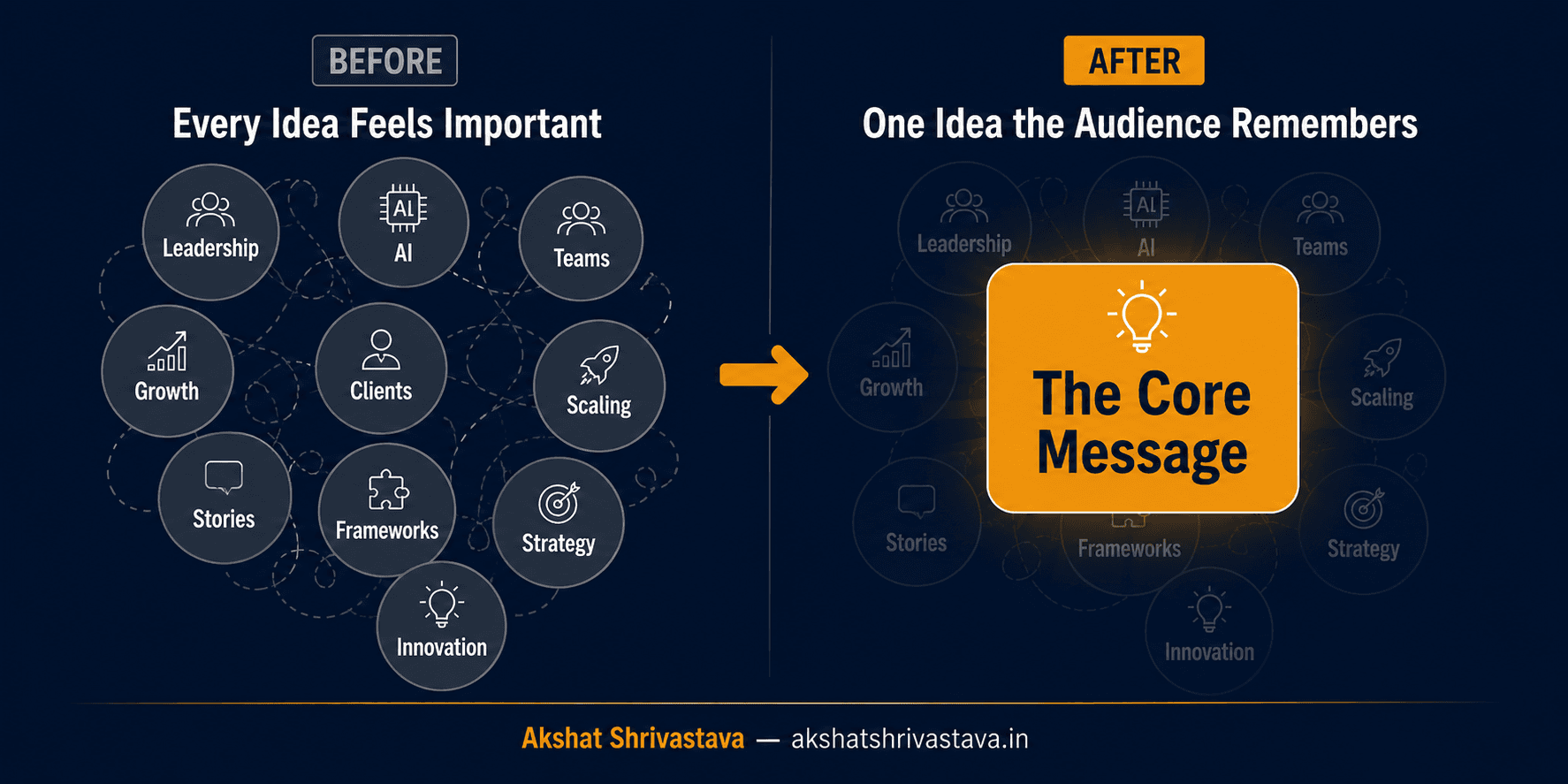
With Andrea, arriving at that central message took longer than either of us expected. We spent nearly an entire coaching session refining one sentence that captured exactly what he wanted the audience to remember after they walked out of the room.
Some people would consider that excessive.
I consider it the most important part of keynote preparation.
Once that sentence became clear, every decision afterwards became easier. Stories either strengthened the message or they didn’t. Frameworks either supported it or distracted from it.
Clarity removes complexity.
This is where keynote preparation becomes emotionally difficult.
Every founder has an emotional attachment to their ideas because every idea represents years of experience.
Removing an idea can feel like removing value.
But audiences don’t reward completeness.
They reward clarity.
I remember Andrea asking whether we could somehow fit one more framework into the keynote.
The answer was no.
Not because it lacked value.
Because every additional idea weakened the one idea we wanted people to remember.
One of the biggest mindset shifts speakers need to make is accepting that a keynote isn’t the place to share everything they’ve learned.
It’s the place to share the most important thing they’ve learned.
There will always be another keynote.
Only after the content had been filtered did we begin structuring the keynote.
The goal wasn’t to arrange slides.
The goal was to create a journey.
There are several ways to structure a keynote. You might choose a chronological journey, a problem-to-solution approach, a topical structure, or a past-present-future narrative. The structure itself matters less than one simple principle.
Every idea should naturally lead to the next.
Your audience shouldn’t have to wonder why you’ve suddenly changed topics.
Personally, I like building keynotes around a simple narrative:
Hook → Problem → Insight → Solution → Action
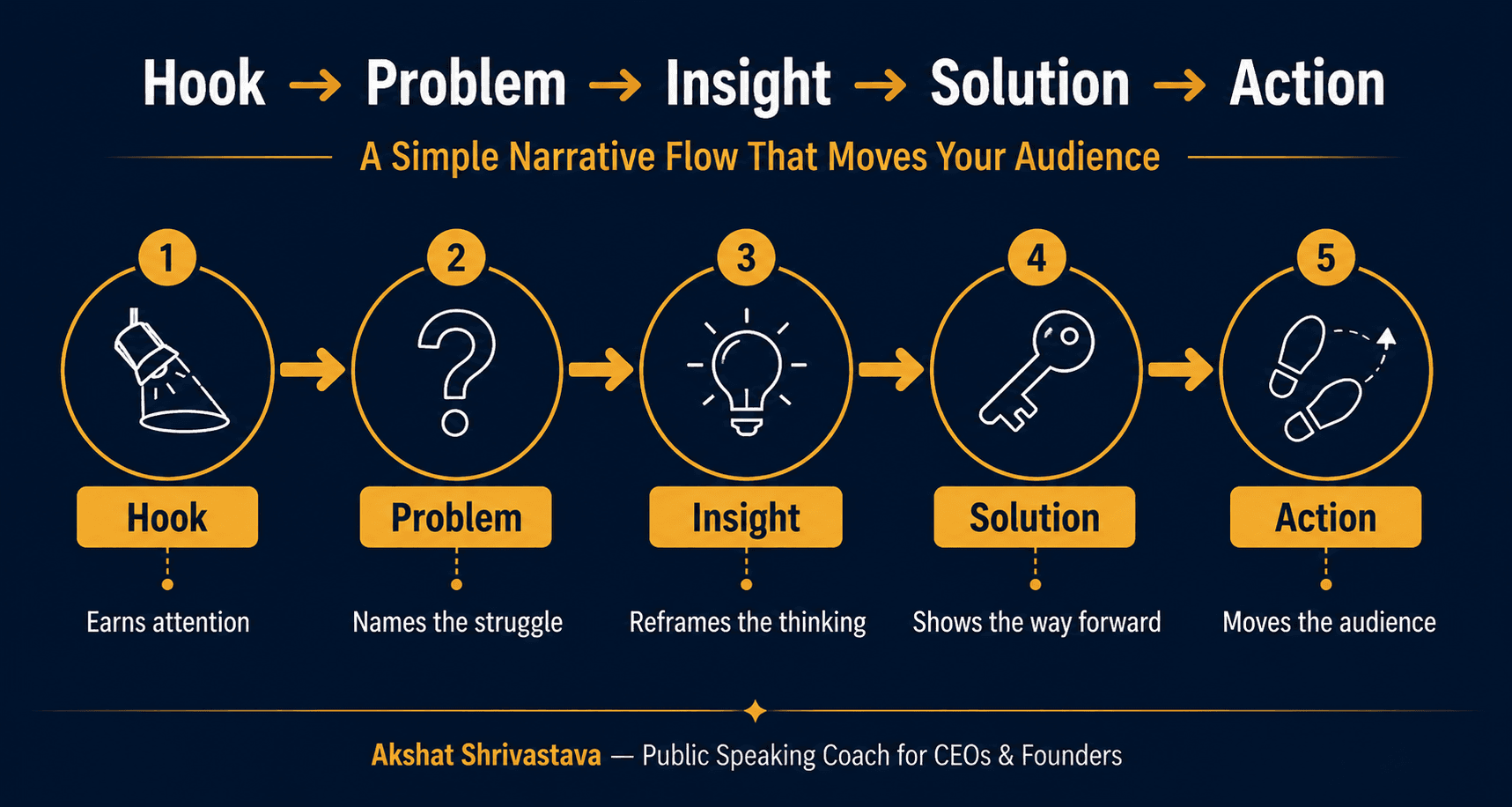
When ideas flow naturally, people stop noticing the structure and start focusing entirely on the message.
That’s when a keynote becomes memorable.
The opening earns attention.
The ending creates memory.
Too many speakers spend weeks perfecting their first five minutes and then allow the speech to fade away with a simple “Thank you.”
Instead, think intentionally about both.
Open with something that immediately creates curiosity. It could be a story, a surprising statistic, a thought-provoking question, or a bold statement that challenges conventional thinking.
Then finish by returning to your core message.
The audience may forget individual examples, but they’ll remember how your keynote made them think and feel.
That’s what great endings do.
By the time Andrea boarded his flight to Vietnam, his keynote had been complete for almost a week.
While many speakers were still making last-minute changes to their slides, he was simply rehearsing. He knew exactly what he wanted to say, how he wanted to say it, and what he wanted the audience to remember.
The keynote itself was a success, but what happened afterwards was even more meaningful.
Attendees followed him into a private workshop where he introduced a brand-new AI venture and converted multiple participants into clients. One well-crafted keynote didn’t just generate applause. It created business opportunities and strengthened his position as an authority in his industry.
That is the real power of a keynote.
The goal isn’t to impress people with everything you know.
It’s to change the way they think about one important idea.
The speakers who leave a lasting impression aren’t the ones with the most knowledge.
They’re the ones who have the discipline to organize that knowledge into a message people will still remember long after the conference is over.
How long should a keynote speech be?
It depends on the invitation, not a fixed rule. Andrea’s keynote was 40 minutes. What matters more than the exact length is that every minute serves one core message, a tightly structured 20-minute talk will always outperform a rambling 45-minute one.
How many main ideas should a keynote have?
One. That’s not a simplification. It’s the whole point of Step 3. Audiences don’t remember ten lessons. They remember one idea that changes how they think. Everything else exists to support it.
What’s the best structure for a keynote speech?
There’s no single template, but a structure that consistently works is Hook → Problem → Insight → Solution → Action. The exact format matters less than making sure every idea leads naturally into the next one.
How do I decide what to cut from my speech?
Ask whether an idea strengthens your core message or distracts from it. If it doesn’t directly support the one thing you want the audience to remember, it belongs in a different keynote, not this one.
If you’ve been invited to deliver a keynote and want it to become more than just another presentation, I’d love to help.
Over the past decade, I’ve coached CEOs, founders, and business leaders from around the world to transform years of expertise into keynote speeches that build authority, create business opportunities, and leave audiences with a message they remember. Whether you’re preparing for your first conference or speaking on an international stage, the process remains the same: understand your audience, identify your core message, structure your ideas into a compelling narrative, and rehearse until you can deliver with confidence and presence.
If you have an upcoming keynote and would like to prepare it together, reach out to me. Through the Keynote Mastery Program, we’ll work one-on-one to shape your message, strengthen your stories, refine your delivery, and ensure you walk onto the stage with complete clarity and confidence.
The stage is already yours. Let’s make sure you own it.