
Table of Contents
- Why Most Keynote Speeches Fall Flat
- Step 1: Know Your Audience Better Than They Know Themselves
- Step 2: Start With the End in Mind
- Step 3: Build Your Speech Around a Story
- Step 4: Speak Before You Write
- Step 5: Structure It for Maximum Impact
- Step 6: Edit Like a Pro, Perform Like a Natural
- Final Thoughts: Writing Helps You Speak With Authority

Have you ever wondered why some keynote speeches feel flat—while others connect instantly?
Most keynote speeches are forgotten the moment people leave the room.
Not because the speaker lacked expertise, but because the speech never truly connected. It sounded generic. It leaned too heavily on data. Or it tried to impress instead of resonate.
That’s the real problem with many keynote speeches. They talk at the audience, not to them.
Writing a keynote speech isn’t about memorizing lines or cramming insights. It means having a clear message, understanding who you’re speaking to, and structuring your ideas in a way the audience can follow and remember.
Once you understand how to write a keynote speech with intention—using the right structure, stories, and flow—everything changes. Your speech feels natural. Your message lands. And the audience walks away remembering what you said, not just that you spoke.
In Six steps I will guide you to learn a practical, repeatable process to write a keynote speech that feels like you and actually stays with your audience long after the applause ends.

Before I write a single line of a keynote speech, I ask myself one question:
Who am I really speaking to?
A while ago, I attended a conference where an Instagram influencer was invited as a keynote speaker. She had built a massive following by creating relatable content for young people. Online, she was sharp and engaging. On stage that day, however, something felt off.
The audience in the room was mostly middle-aged and senior professionals. As she spoke, I could see the disconnect. The content wasn’t bad—but it wasn’t built for them. She hadn’t spent enough time understanding who was sitting in front of her.
That experience reinforced something I see over and over again in my coaching work:
if you don’t understand your audience, your speech will never fully land.
This is the real foundation of how to write a keynote speech people remember. Your audience decides your tone, your stories, your examples, and even the language you use. When speakers skip this step, their talks sound generic—even when the ideas are solid.
Whenever I work with a client on a keynote, I make sure we answer a few simple questions first:
- Who exactly is this audience?
- What does a typical day in their life look like?
- What problems are they trying to solve right now?
- What do they already believe about this topic?
Once these answers are clear, everything becomes easier. You stop trying to impress. You start trying to connect.
A keynote speech is never about saying everything you know.
It’s about saying the right things to the right people, in the right way.
One of the biggest mistakes I see speakers make is this:
They start writing the speech before they decide the message.
I’ve seen this again and again with my clients. They open a document, start adding ideas, stories, frameworks—and only later try to figure out what they actually want the audience to walk away with.
That approach never works.
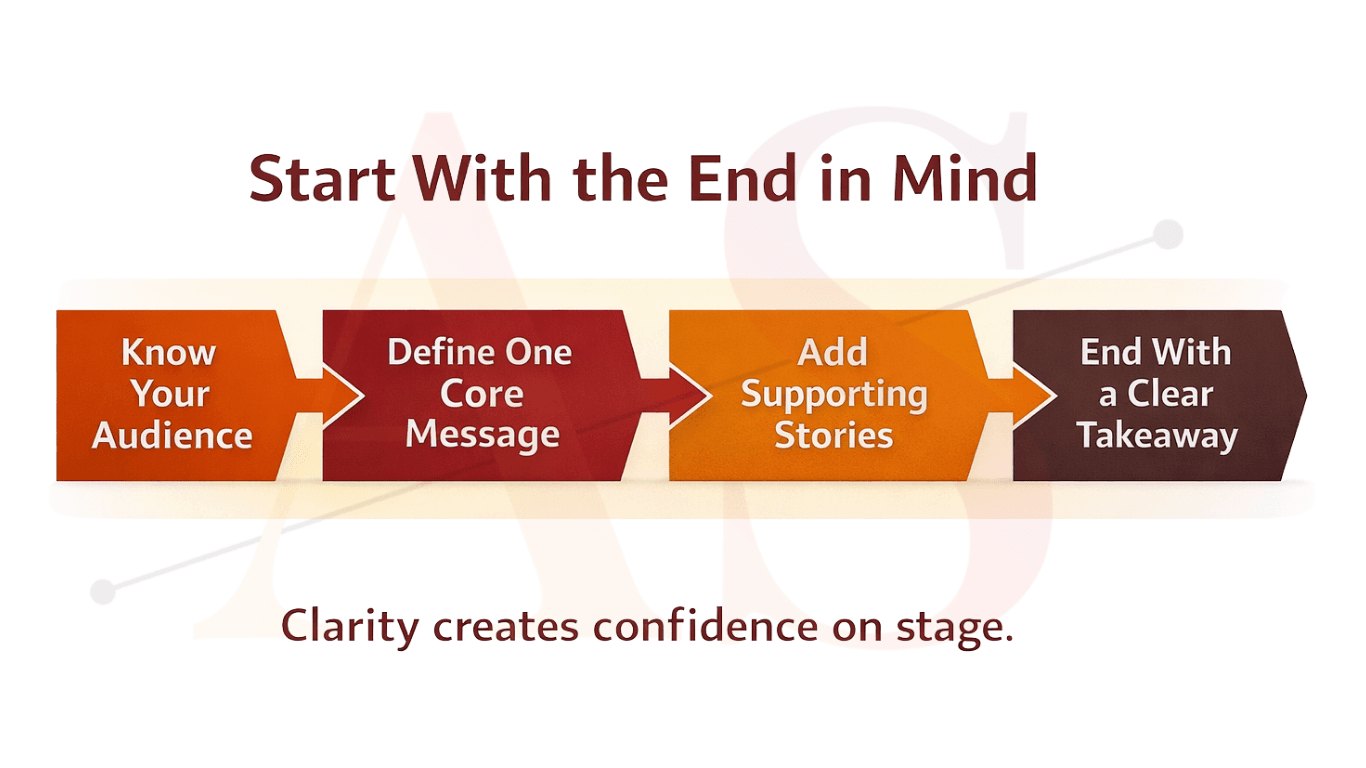
When I work with someone on how to write a keynote speech, the first thing we do—before slides, stories, or structure, is define the end.
I always ask them:
If the audience remembers just one thing from your talk, what should it be?
Your keynote speech will usually have one dominant purpose:
- To inform
- To inspire
- To persuade
- Or to entertain
Trying to do all four at once is where most speeches lose clarity.
Once the purpose is clear, we distill the core message into a single sentence—usually no more than 10 to 12 words. This sentence becomes the anchor for the entire talk. Every story, example, and insight either supports it or gets removed.
This step is critical to building a strong keynote speech structure.
Without a clear destination, even well-delivered speeches feel scattered.
I often tell my clients this:
Writing a keynote without a clear message is like starting a journey without knowing where you’re headed. You’ll move, but you won’t arrive where you intended.
Once the message is locked, everything changes. Writing becomes easier. Editing becomes sharper. And when you finally step on stage, you’re not trying to remember lines, you’re simply reinforcing a message you already know inside out.
That’s when a keynote stops feeling heavy and starts feeling natural.

If there’s one thing that separates forgettable speeches from memorable ones, it’s this: Stories.
A few years ago, I coached a senior leader from San Francisco. In our first few conversations, he told me something I hear surprisingly often:
“Akshat, I find it very hard to remember my own speeches.”
When I watched him speak, the reason became clear almost immediately.
His talks were filled with data, insights, opinions, and frameworks. Everything was logical. Everything was well-researched. But there were almost no stories. As a result, the speech felt heavy—both for him and for the audience.
This is a classic mistake speakers make when they don’t understand the power of storytelling in speeches.
So we changed the approach completely.
Instead of building the speech around information, we built it around one core story. Then we layered data, facts, and insights around that story. Something interesting happened. The speech became simpler. Easier to deliver. Easier to remember. And far more engaging for the audience.
This is something I’ve seen consistently across keynote speech that truly works.
When you anchor your message in a story, your audience doesn’t have to work hard to follow you—they’re already with you.
Stories don’t just make a speech emotional. They make it clear.
Whether it’s:
- A personal experience
- A client transformation
- A moment of failure or realization
- Or a story that shaped your thinking
…the story gives your message a spine. Everything else supports it.
If you want your keynote to feel natural instead of rehearsed, this is where it starts.
Don’t ask, “What information should I share?”
Ask, “What story best carries my message?”

If you’ve ever opened a blank document and felt your mind go empty, you’re not alone. I’ve seen this happen with beginners and experienced speakers alike.
A lesson that changed how I work on speeches came from the World Champion of Public Speaking, Aaron Beverly. He once said that starting a speech from zero—from a completely blank page—can make even the best speakers feel stuck.
Instead of fighting that, I do the opposite.
Before I write anything, I speak.
I ask my clients to talk through their ideas out loud, exactly the way they would explain them to a friend. We record it. No structure. No filtering. Just flow. This works because speaking is how we naturally think. Writing comes later.
This step plays a big role in learning how to write a keynote speech without overthinking every line.
Once the ideas are spoken out, we transcribe them and start shaping them into a coherent flow. By then, the hardest part is already done. You’re no longer staring at a blank page—you’re refining something that already exists.
This approach also improves delivery. When your speech starts as spoken language, it sounds like you on stage, not like an article being read out loud. That’s one of the simplest yet most effective public speaking tips I share with my clients.
Writing has its place. But speaking first removes pressure, builds confidence, and keeps your voice authentic.
If writing feels hard, don’t force it.
Talk first. Let the words find you.
After attending countless conferences, I started noticing a pattern.
Most speeches don’t lose the audience in the middle—they lose them right at the start.
I was once at an event where six speakers came on stage one after another. Almost all of them opened the same way. Someone thanked the organizers. Someone introduced themselves. Someone jumped into a random story without context.
By the third speaker, the audience had already checked out.
That’s when structure becomes non-negotiable.
Every memorable keynote I’ve seen—or helped create—follows a simple keynote speech structure. It’s the same structure we instinctively respond to in movies and stories.
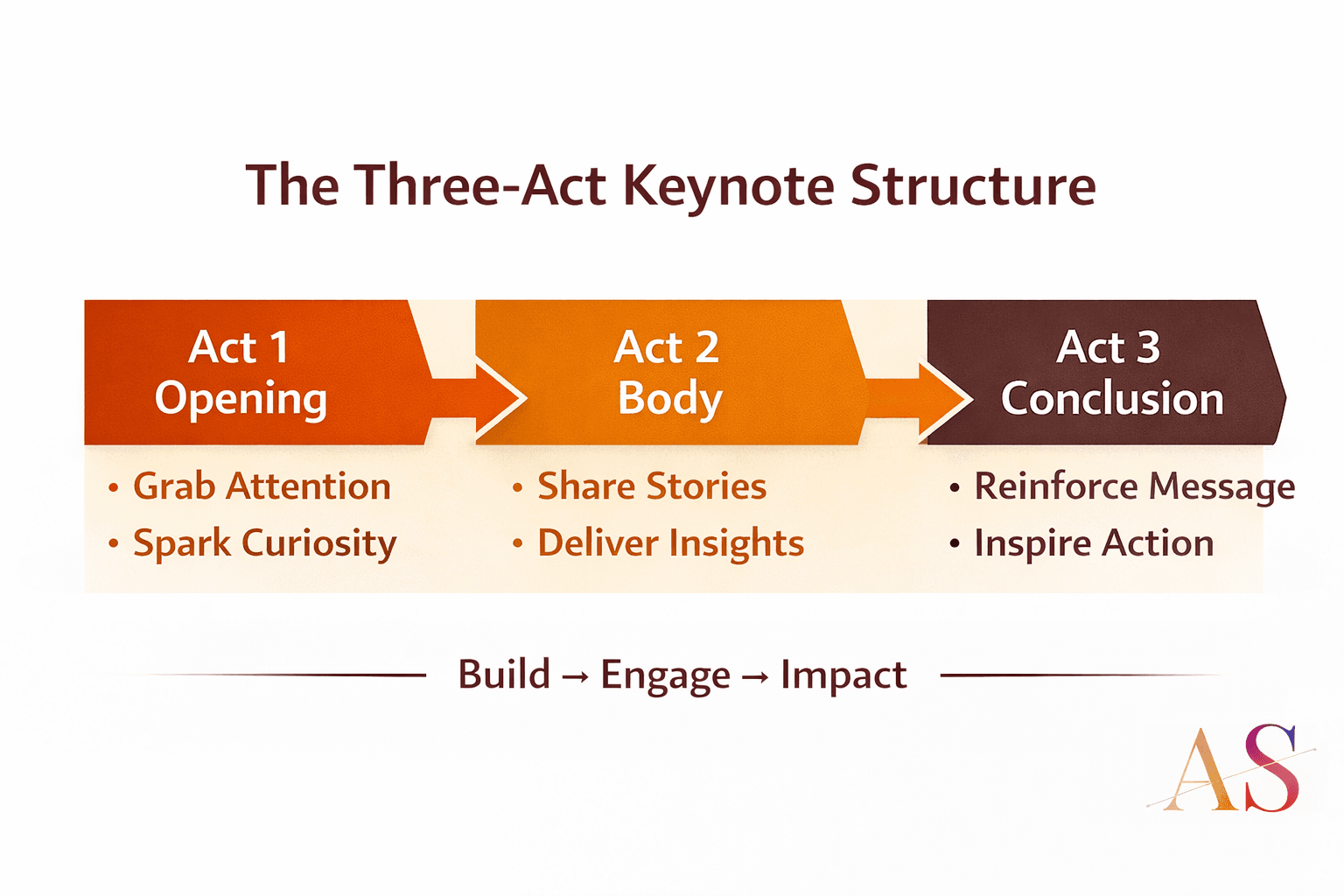
I like to think of it in three acts.
This is where you earn attention. One of my favorite ways to start a speech is very simple. Walk on stage. Pause. Smile. Look at the audience. Let the silence do some work. Then ask a powerful question.
No rush. No filler.
This is where your core message lives. Your stories, insights, and examples belong here. I always encourage speakers to use verbal signposts like “Let me share the second idea” or “Here’s what this means for you.” It helps the audience stay oriented instead of mentally drifting.
Don’t fade out. Close with clarity. Reinforce the message you defined earlier. Let the audience leave knowing exactly what you wanted them to take away.
This structure does more than help the audience.
It helps you.
When your speech is structured well, you don’t rely on memory alone. You know where you are, where you’re going, and what comes next. That’s one of the most underrated public speaking tips I give speakers who struggle with confidence on stage.
A strong structure turns anxiety into flow.
It turns ideas into impact.

One of the biggest myths in public speaking is that great speakers write perfect speeches in one go. In my experience, that almost never happens.
While preparing for my international speech contest in 2019, I didn’t stop at one draft. I created 17 versions of the same speech. Each version was clearer, tighter, and more impactful than the last. Not because I was adding more—but because I was refining.
This is one of the most practical public speaking tip I can share:
Your first draft is not supposed to be good. It’s supposed to exist.
Editing is where your speech finds its rhythm. This is where you start adding tools that elevate delivery without making it sound rehearsed:
- Metaphors that simplify complex ideas
- Triads like “clarity, confidence, connection”
- Short, deliberate pauses
- Lines that create emphasis and release
I always remind my clients that a keynote speech isn’t meant to be read. It’s meant to be performed. Editing helps you strip away what doesn’t serve the message and strengthen what does.
This final stage ties everything together—understanding your audience, clarifying your message, using stories, and applying structure. It’s the last step in learning how to write a keynote speech that feels natural on stage and memorable for the audience.
You don’t need 17 drafts. But even three or four focused revisions can completely transform how your keynote feels when you deliver it.
Write freely. Edit intentionally.
Then step on stage and speak like yourself.

A powerful keynote isn’t built by memorizing lines or trying to sound impressive. It’s built through clarity—clarity about your audience, your message, and the story you want to leave them with.
When you take the time to write your keynote properly, something important shifts. You stop worrying about what to say next and start focusing on how to connect. The structure guides you. The stories ground you. And the message gives you confidence on stage.
Over the years, I’ve seen this repeatedly. Speakers don’t struggle because they lack ideas. They struggle because those ideas aren’t shaped into a clear, memorable experience for the audience. Writing forces that clarity. It helps you cut the noise, strengthen your message, and speak with authority instead of anxiety.
If you’re preparing for a high-stakes keynote and want focused, personalised guidance, my Keynote Mastery Program is designed to help you craft and deliver a keynote that feels clear, confident, and impactful—without sounding scripted or forced.
If a keynote is coming up and you want to get it right, this is the work we do inside Keynote Mastery Program.
A standout keynote isn’t about sounding smart.
It’s about being real, being intentional, and making your message land.
When your message is clear, your voice becomes confident.
And that’s when people remember what you said long after the applause ends.