Over the last six years, I’ve coached more than 100 leaders to speak on big stages.
This is the keynote preparation timeline I rely on with busy Founders and CEOs, especially when time is tight
Some of the CEOs I coached have spoken at international events such as SEO Mastery Summit in Vietnam, Digital Marketers Australia, and the Phuket AI Marketing Summit. Others have delivered keynote speeches at company off-sites, industry conferences, investor events, and leadership summits.
One thing I’ve learned is this.
The quality of a keynote is rarely determined by the intelligence of the speaker.
It is usually determined by the quality of preparation.
Although every event is different, my preparation process always begins with the same three questions.
- What event are you speaking at?
- Who will be sitting in the audience?
- When is the event?
The third question is more important than most people realize.
It tells me how much time we have to think, write, practice, refine, and prepare.
The best speakers don’t simply prepare harder.
They prepare earlier.
Why Preparation Matters Even More for Busy Founders
The CEOs and Founders I work with are incredibly busy.
They’re running companies, leading teams, managing customers, making strategic decisions, travelling, and solving problems every day.
Very few of them can dedicate hours every evening to keynote preparation.
Because of that reality, I have continuously refined my coaching process.
My goal has never been to make people spend more time preparing.
My goal has always been to help them prepare smarter.
I want every hour invested in keynote preparation to create the maximum possible impact on stage.
That’s why I usually recommend beginning keynote preparation six to eight weeks before a major event.
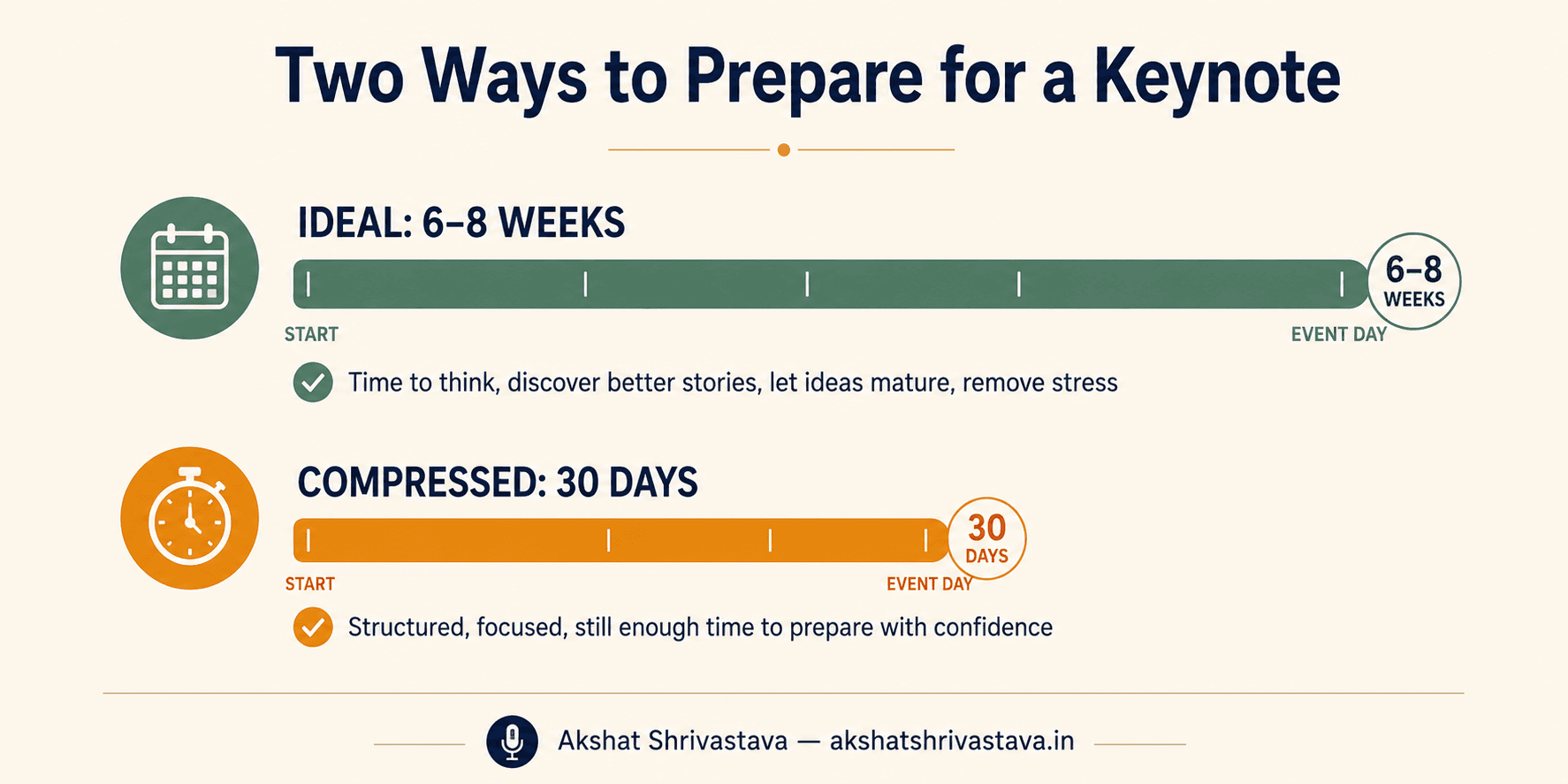
Those extra weeks give you space to think.
They help you discover better stories.
They allow ideas to mature naturally instead of forcing them at the last minute.
Most importantly, they remove stress.
Unfortunately, many leaders don’t have six weeks.
Sometimes the invitation arrives late.
Sometimes business priorities take over.
Sometimes the keynote simply gets pushed to the bottom of the priority list until it becomes urgent.
When that happens, I follow a structured 30-day preparation plan.
The Keynote I Prepared in 30 Days
Last year, I was invited to deliver a keynote at JECRC University in Jaipur.
More than 2,000 students were expected in the audience.
My speaking slot was approximately 40 minutes.
Now here’s something many people assume incorrectly.
I’ve spoken on stage more than 500 times over the last twelve years.
People often think that experience means I don’t need to prepare anymore.
The opposite is true.
The more experience I gain, the more seriously I take preparation.
Every keynote represents my personal brand.
Every audience is giving me their time and attention.
Every speech is an opportunity to create an experience that people remember long after they leave the auditorium.
I never walk onto a stage assuming experience alone will carry me.
I prepare.
Every single time.
Every keynote is different, but the preparation process below is the same framework I return to whenever I have limited time to prepare.
Here’s the exact 30-day keynote preparation framework I recommend to busy Founders when time is limited.
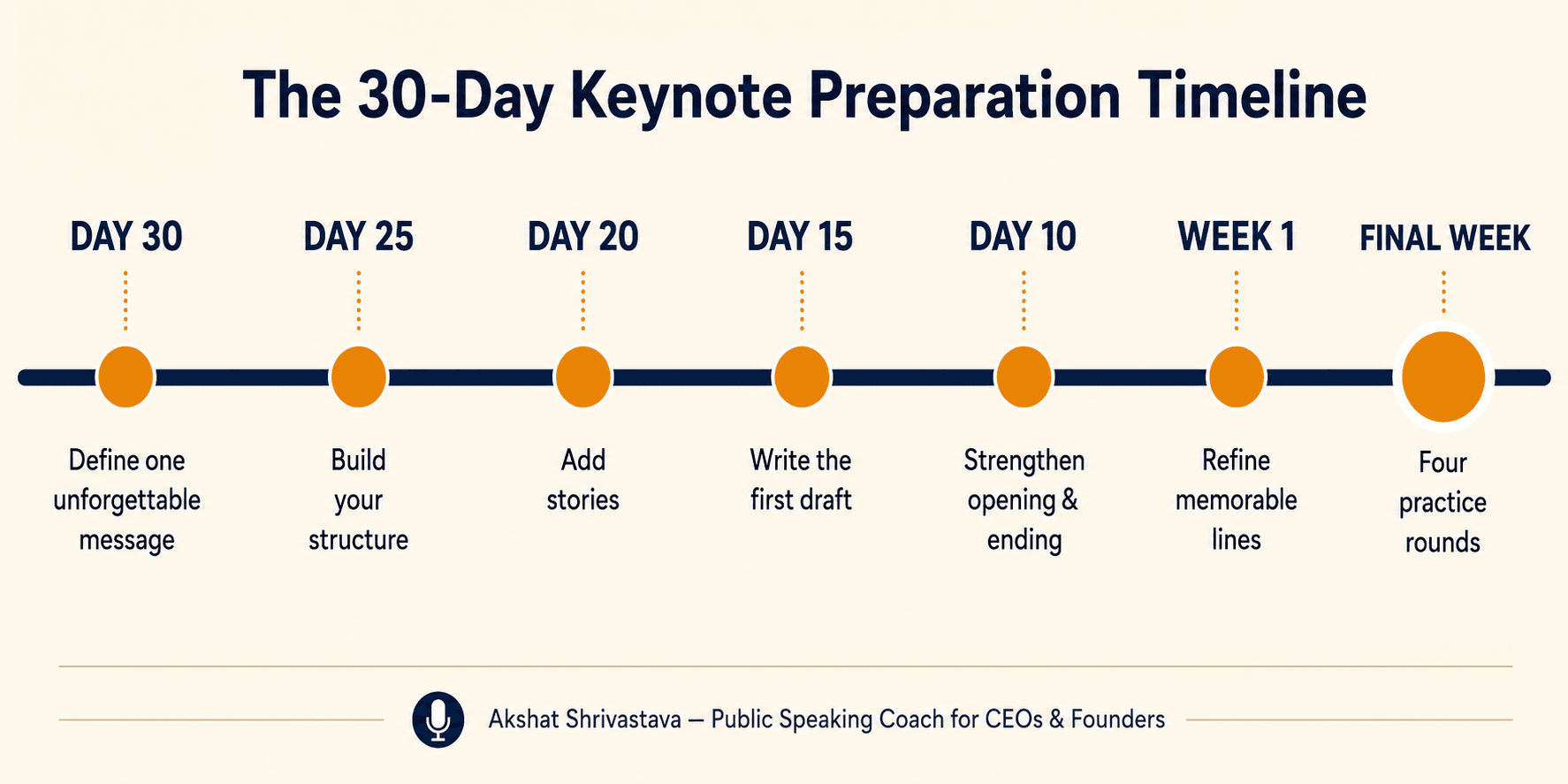
My 30-Day Keynote Preparation Timeline 30 Days Before the Event: Define One Unforgettable Message
I always begin with one simple question.
If someone remembers only one sentence from my keynote six months later, what should that sentence be?
That becomes the core message.
Usually, it is just one sentence containing around 10 to 12 words.
Everything else in the keynote supports that single idea.
If your audience remembers everything, they remember nothing.
If they remember one powerful idea, your keynote has succeeded.
Around 25 Days Before: Build Your Structure
Once the core message is clear, I create the overall flow.
I list the major ideas that support the message.
Then I arrange them into a logical journey.
Instead of asking, “What do I know?”
I ask,
“What does my audience need to hear next?”
A great keynote feels like a conversation rather than a collection of information.
If you’re working through this stage and have more expertise than time to organize it, my guide on how to structure a keynote speech when you have too many ideas walks through the full process step by step.
Around 20 Days Before: Add Stories That Bring Ideas to Life
Facts educate.
Stories move people.
This is where I spend a significant amount of time.
I look for experiences from my own journey.
Sometimes it’s a client transformation.
Sometimes it’s a personal failure.
Sometimes it’s a small observation that carries a much bigger lesson.
Every story should help the audience understand the message more deeply.
Stories are not entertainment.
They are evidence.
Around 15 Days Before: Write the First Complete Draft
Only after the structure and stories are clear do I write the keynote.
At this stage, I don’t try to make it perfect.
I simply focus on getting every important idea onto paper.
Perfection comes later.
Momentum comes first.
If you want the full process behind shaping a first draft into a keynote that audiences remember, I’ve written about it in detail in how to write a keynote speech.
Around 10 Days Before: Strengthen the Opening and the Ending
Most audiences remember two moments more than anything else.
How you begin.
How you finish.
I spend extra time crafting both.
The opening should earn attention immediately. If you want the specific techniques I use here, I’ve laid out five of them in how to open a keynote speech.
The closing should leave people thinking long after they have left the room.
Around One Week Before: Refine Memorable Lines
This is where I polish.
I rewrite sentences.
I simplify language.
I remove unnecessary words.
I strengthen transitions.
I look for powerful phrases that people might write down, remember, or quote later.
The goal isn’t to sound clever.
The goal is to sound clear.
The Final Week: Four Practice Rounds Before You Step Onto the Stage
Once the content feels complete, the final week is about rehearsal, not rewriting. I run every keynote through the same four practice rounds.
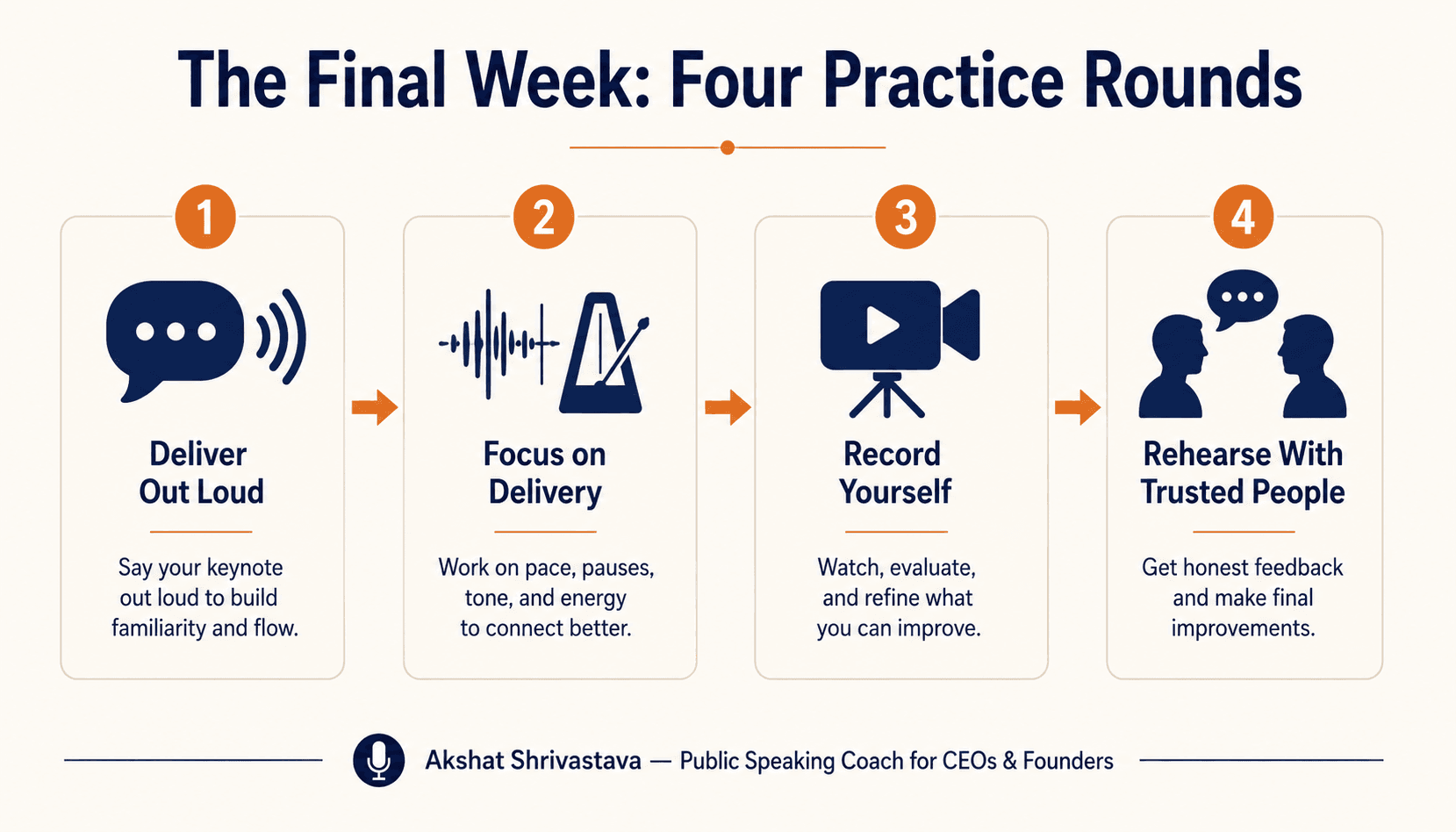
Practice 1: Deliver the Keynote Out Loud
I deliver the keynote aloud from beginning to end.
This practice isn’t about memorization.
It’s about identifying awkward transitions, confusing sections, or ideas that don’t flow naturally.
Speaking exposes problems that reading never does.
Practice 2: Focus on Delivery
Now I focus entirely on delivery.
I work on:
- Voice modulation
- Pauses
- Energy
- Pace
- Emphasis
- Emotional variation
A great keynote isn’t only about what you say.
It’s about how people feel while listening.
Practice 3: Record Yourself
I record myself.
Then I watch the recording like a coach rather than a speaker.
I observe:
- Body language
- Eye contact
- Facial expressions
- Hand gestures
- Stage movement
- Posture
The camera never lies.
It reveals habits that are impossible to notice while speaking.
Practice 4: Rehearse in Front of Trusted People
Finally, I rehearse in front of trusted people.
I invite honest feedback.
Not compliments.
Feedback.
Fresh eyes often notice what we completely miss.
A small suggestion at this stage can dramatically improve the final keynote.
It's Time to Step Onto the Stage
Most people believe confidence comes from talent.
I don’t.
I believe confidence comes from preparation.
Every great keynote I’ve delivered has been built long before I walked onto the stage.
The stage is simply where preparation becomes visible.
If you have a keynote coming up in the next few weeks, don’t wait until the last few days.
Give yourself time to think.
Time to write.
Time to practice.
And most importantly, time to become the speaker your audience deserves.
Frequently Asked Questions
Whenever possible, I recommend starting six to eight weeks before your event. That gives you enough time to think, refine your ideas, and practice without feeling rushed. If you have less time, a structured 30-day preparation plan can still help you deliver a strong keynote.
Yes. While more preparation time is always helpful, I’ve found that 30 days is enough when you follow a structured process and focus on the right priorities instead of trying to perfect everything at once.
No. I don’t practice to memorize every word. I practice so the ideas flow naturally, the transitions feel smooth, and I can stay present with the audience instead of worrying about the script.
For me, it starts with defining one clear message. If your audience remembers one meaningful idea long after your keynote, you’ve achieved something far more valuable than simply delivering information.
Need Help Preparing a High-Stakes Keynote?
If you’re a CEO or Founder preparing for an important keynote, conference, investor presentation, or leadership event, I’d love to help.
I work closely with leaders to shape clear ideas, compelling stories, and memorable delivery so they can step onto the stage with authority and create lasting impact.
If you have an important presentation coming up, explore Keynote Coaching and get the structured support you need to prepare, rehearse, and deliver with confidence.